Water Street in Burlington Illinois Renamed James “Jimmy” Weberpal Way June 2022!

I received today (Thursday June 23, 2022) the below photo in my email. The photo shows the dedication on Wednesday June 22, 2022 of Water Street in honor of James “Jimmy” Weberpal by the Village of Burlington in Burlington Township Kane County Illinois.

Jimmy is the son of Rose Schlick. Rose was the daughter of Joseph and Mary Anne (Armbrust) Schlick. Jimmy prior to passing away in the spring lived in his grandfather’s home at the corner of Main and Water Streets in downtown Burlington for many years. He will be missed by his family members and by the citizens of Burlington. Thanks to Elaine Crawford for emailing me the photo!

People in the picture from left to right: Valerie (the wife of John Weberpal), John Weberpal (son of Don and Maurine Weberpal), Robert Schlick (Son of Clarence and Dorothy Schlick) Don Weberpal (Brother of James Weberpal), Larry Gorenz (son of Bertha Gorenz), Wayne Weberpal (son of James Weberpal), Kathy Gorenz (wife of Larry Gorenz), Maurine Weberpal ( wife of Don Weberpal), Laura ( Lee) Awe ( daughter of Irene [Weberpal] Lee), Junior Lee ( son of Irene [Weberpal] Lee ) and Steven ( Son of Laura (Lee) Awe.

Posted in Uncategorized | Leave a comment

Old Post Cards Reveal Wheaton Illinois at Turn-of-the-Century.

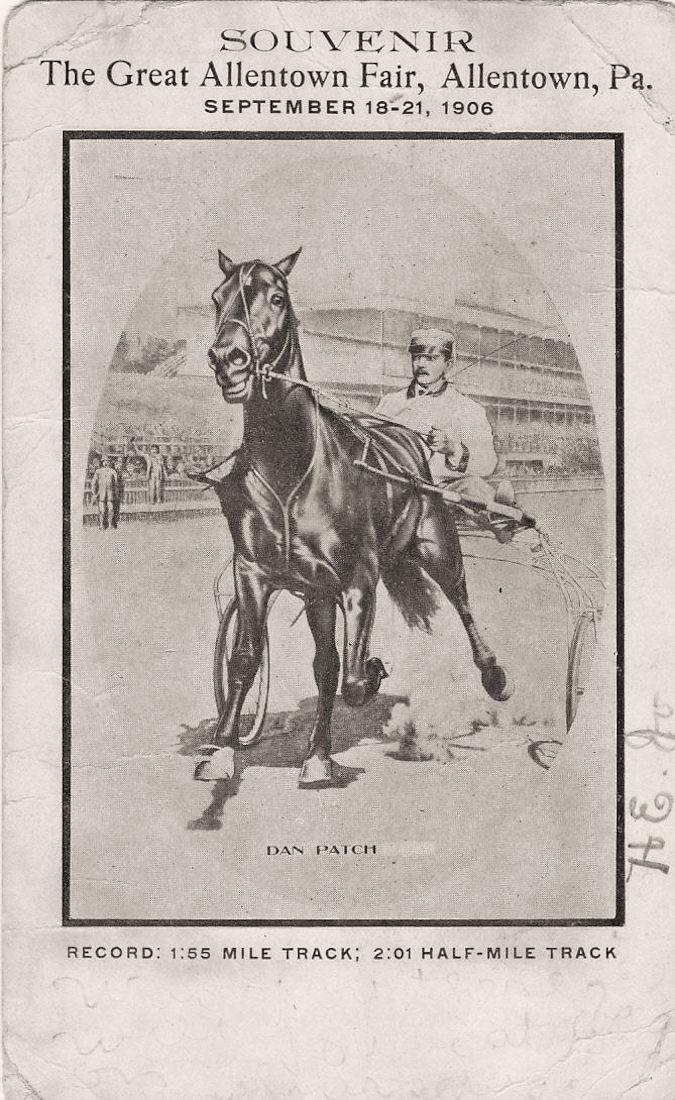
The Schlicks and Daleidens spent time in the City of Wheaton Illinois. I located two post cards several years ago at the Midwest Book Hunters Book Fair.

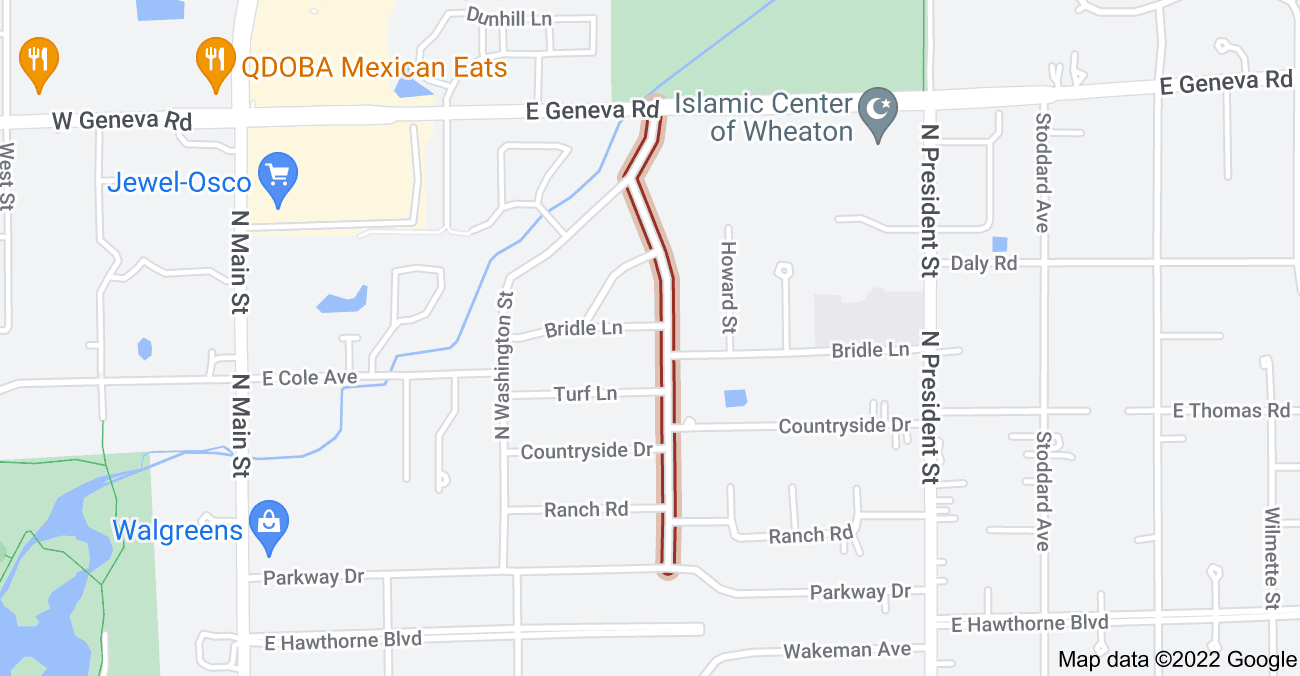
Driving Park Road is show in red above running north and south in the subdivision built by Jay Stream (Founder of Carol Stream, Illinois) and his Durable Contstruction Co. in the 1950s. Note the quaint names of the roads connecting N. Washington Street on the Northside of Wheaton Illinois: Bridle, Turf, Countryside and Ranch. I lived on Turf Lane raising my two daughters in the ninties.

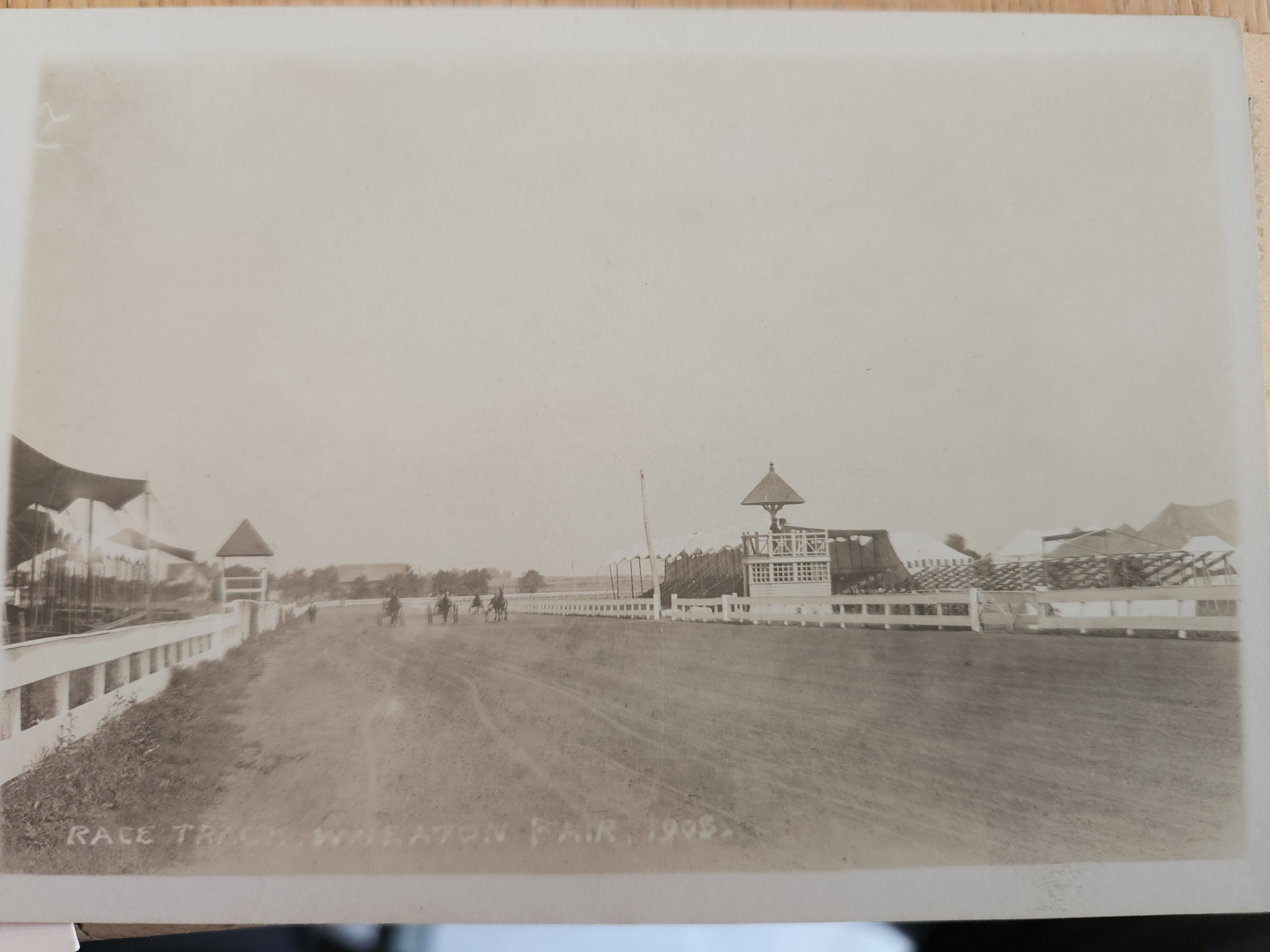
The photo an current map shown above is of the “Driving Park” race track at the Wheaton Fair in 1908. This was formerly located on the north side of Wheaton, Illlinois just south of Geneva Road and east of Main Street near the Wheaton Eye Clinic. There is a lot to take in looking at this photo. There are four people harness racing coming out of a turn. A judge’s stand to the right. Spectator stands to the left and on the inside of the track.

In 1844 Vermonter Daniel Kelley purchased 1,400 acres and settled at “Tall Trees” with his wife to raise Spanish Merino sheep. The Kelleys and their 11 children all became actively involved in Wheaton’s political and business life. Daniel Kelley donated land for the Chicago Great Western Railway, and the area around the railroad stop became known as Gretna after 1887. Gretna was settled by German farm families, largely Roman Catholics from Southern Germany.
In 1853, St. Stephen Catholic Church was built in Gretna and later closed in 1867. When St. Michael Church was opened in Wheaton in 1872, the St. Stephen parishioners were transferred to that parish. The church building was dismantled sometime in the late 19th century. St. Stephen Cemetery, last used for burial in 1910, was located adjacent to the church building. The St. Stephen Cemetery (located north of the Great Western Trail behind Meyer Material Company on St. Charles Road) was rededicated 100 years later on September 12, 2010. (Source: City of Carol Stream website: https://www.carolstream.org/about/history.).

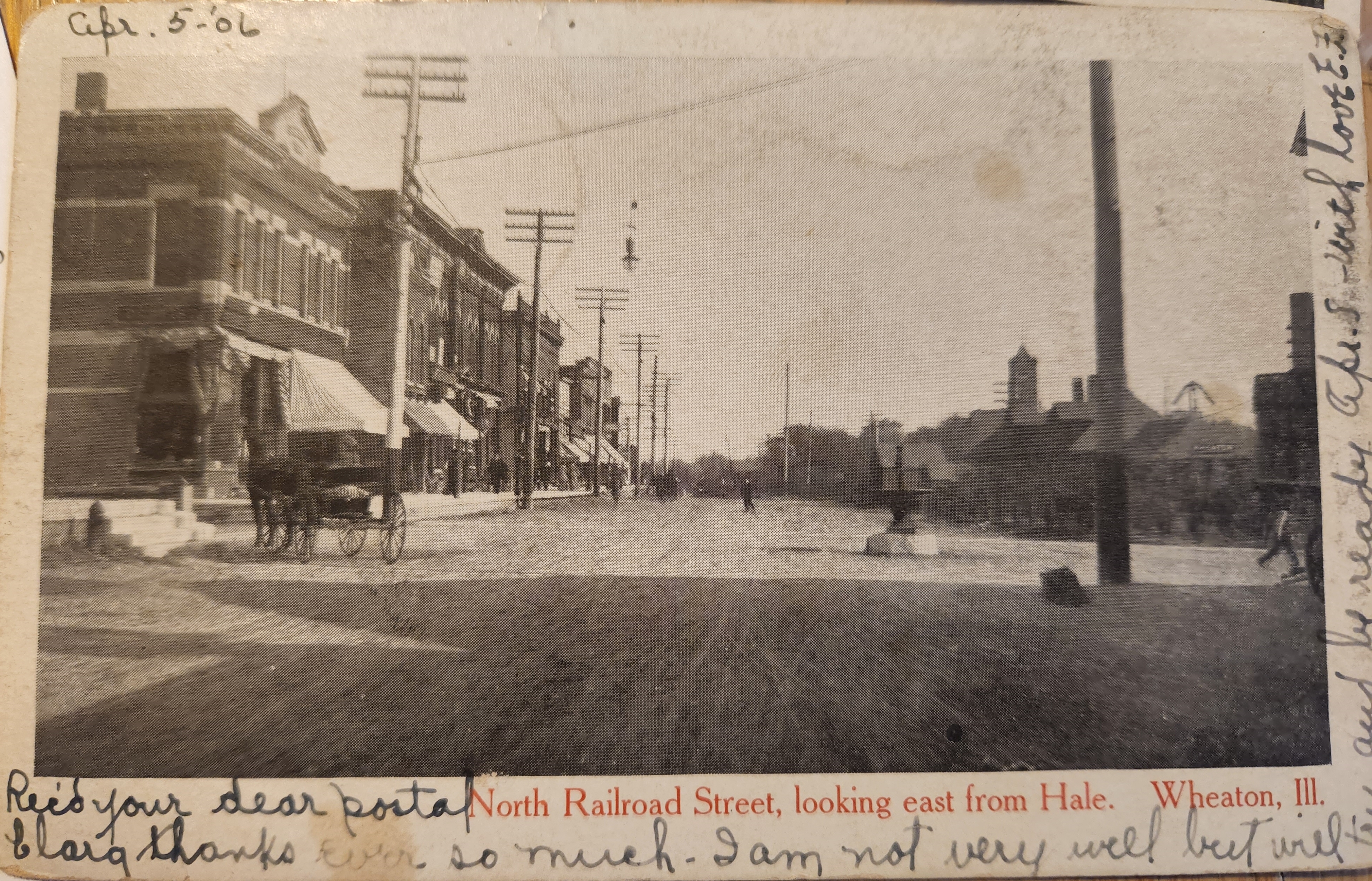
Postcard view of Wheaton Illinois in 1906. This photo was taken “North Railroad [Now Front] Street looking east from Hale.” There is much to observe in this photo: The raised sidewalks, the fountain in the intersection, the DuPage Court House steeple, the horse and buggy, the overhead utility lines, the dirt street, etc. The verso of the postcard (shown below) is addressed to a “Miss Clara Bosma Union Grove, Wis.”. There are two postmarks: Wheaton, Ill April 6 9 am and a second postmark stamped Union Grove, Wis. received April 6 2 pm. Miss Bosma writes on the front around the edges of the photo: “Rec’s you dear postal Clare thanks ever so much. I am not very well but will try and be ready apr. 8 with love E.L” the date of April 5, 1906 is written in the upper left-hand corner. This is truly a snapshot of the past.

Due to the fact that I like “going down rabbit holes”, I searched Clara Bosma’s name for the 1900 Census for Union Grove Wisconsin in Racine County. Clara in 1900 was born in 1891 and was six years old. In 1906 she was nine and one of three children of Mr and Mrs. John and Annie Bosma Clara’s sister were Emma (16) and Ida (13). Clara’s father and paternal grandparents were born in Holland. Perhaps the person writing the note was he mother or a friend visiting relatives or friends in Wheaton.

Posted in Wheaton, Illinois | Leave a comment

John Armbrust the Schlicks and the Building of a Home in 1940 on Beecher Street in Winfield, Illinois.

The former Frank and Mae Schlick home at 27W356 Beecher Street in Winfield Illinois. Frank and Mae were my grandparents. I grew up as a young child in this home from 1961 to 1965 with my sister Mary and my brother Robert. We later moved across the steet to 27W359 Beecher Street. The 359 address was purchased and owned by Christopher Daleiden and later owned by Casper Schlick. Albert Schlick Casper’s son lived at the 27W359 Beecher Street home. Albert was an Engineer for the Chicago and Northwestern Railroad. When Albert moved his family to West Chicago my family moved into the home. I lived at 359 from the mid-nineteen sixties until I went away to college in 1982. Beecher Street where the Schlick and Daleidens lived or owned property from the early 1900s until 2020.

My grandparents Frank and Mae Schlick during the months of May and June in 1940 were in the middle of building their home at 27W356 Beecher. While the Schlick family was involved in building a new home, the American people in 1940 were still crawling out of the negative economic effects of the Great Depression. In Europe, World War II had begun in September of 1939 with the Nazis invasion of Poland. America would not enter the fight until December 1941 with the Japanese attack on December 7 1941 on Pearl Harbor.

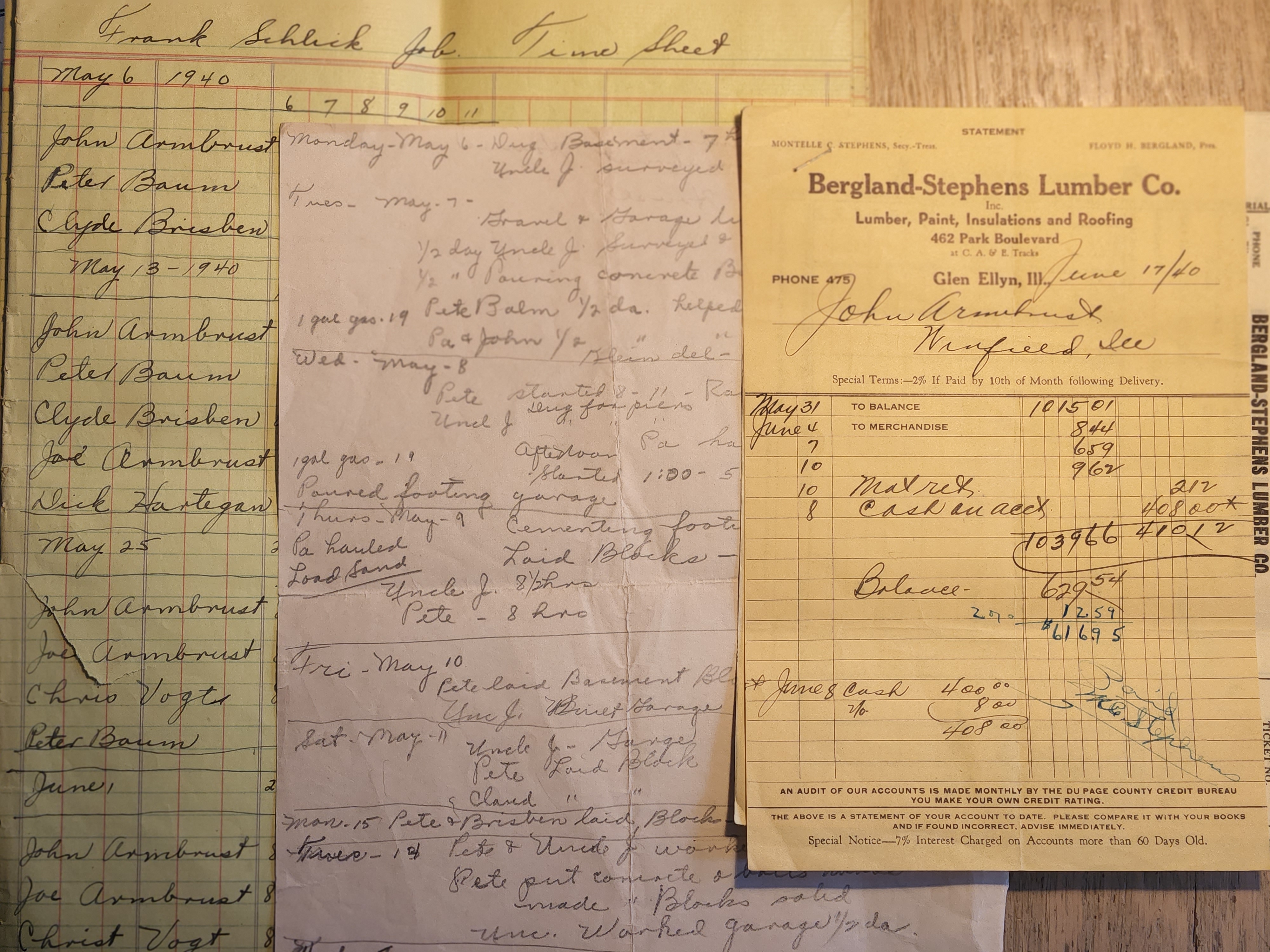
Family documents reveal the details and cost of building the Schlick home at 27W356 Beecher in Winfield Illinois in 1940. (Source: Frank J. and Mae C. Schlick Estate Archives).

The handwriting on two of the above documents belong to my Grandmother Mae Catherine (Hodous) Schlick. The yellow ledger sheet (shown in the above photo on the left) is titled “”Frank Schlick Job Time Sheet“. My grandmother tracked the names of Winfield residents working on building the house, the amount of time each worked on the house, their pay per hour (ranging from $0.85 cents to $0.60 cents per hour) and the dates they worked on the property and home (May 6, 1940 to June 22, 1940).

The names of people who worked on the new Schlick home include: John and Joe (Joseph) Armbrust, Peter Baum, Clyde Brisben, Dick (Richard) Hartigan, Chris Vogt and William McDonald. John Armbrust was my grandfather Frank Schlick’s uncle. John was married to Katherine Daleiden the daughter of Christopher Daleiden. Dick Hartigan in the future would own Hartigan’s Standard Oil Gas Station and Automobile Repair Shop. The Standard Station was located at the corner of Jewell and Church Street north of the Chicago and Northwestern Railroad tracks. Peter Baum was on the volunteer fire dept, played baseball on the Winfield baseball team on the 1933 “Third Wheel Baseball League” sponsored by the Chicago, Aurora, & Elgin Interurban Railline. The Baum’s also owned a shop in town for a period of time.

My Grandfather Frank J. Schlick (as a teenager) is on the far left and John Armbrust is on the far right. John married Catherine Daleiden the sister of Susan Schlick.

On the middle sheet of paper (shown in the above photo) is a diary my Grandmother kept tracking when work was completed and on what day. In reviewing the diary grandma writes that gasoline was $0.19 per gallon! John Armbrust worked on surveying and laying out the placement of the house and the garage on the property. Grandma also records that it “rained” on Wednesday, May 8th during the laying of the piers for the garage. The men only worked from 8:00 a.n. until 11:00 a.m. on that day due to the rain and they went back to work between 1:00 to 5:00 p.m.. My grandfather noted by his nickname “Pa” hauled and loaded sand. It took seven hours to dig the basement on Monday May 6th.

The smaller receipt sheet(s) (shown in the photos above on the right) the cost of materials to build the house. John Armbrust had an account with the Bergland- Stephens Lumber Co. located in Glen Ellyn, Illinois at 462 Park Boulevard. The receipts note the Co. is “at the C.A. & E Tracks” this was the electric interurban railroad line called the Chicago, Aurora and Elgin. A rough estimate given the receipts reveal when added up list $2,200 was spent on building materials and over $638 was spent on the labor to build the home. Estimated total cost for the project was over $2,800.

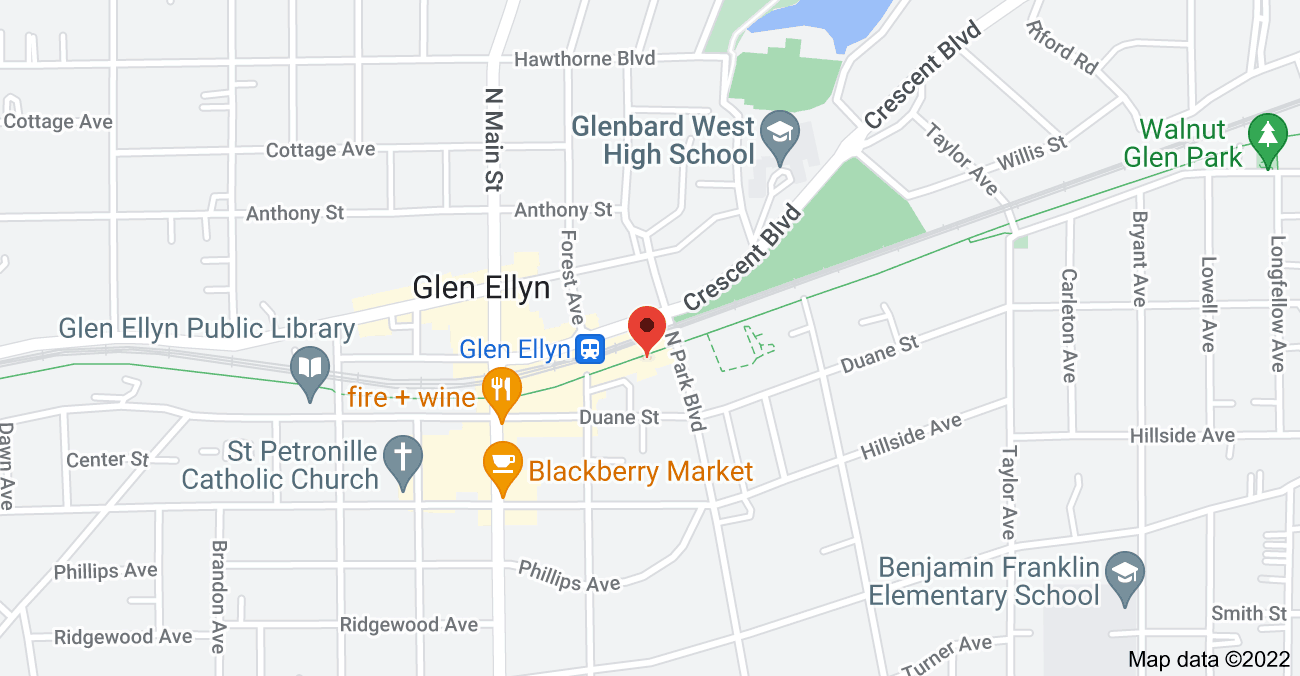
This is the former location of the Bergland – Stephens Lumber Co. (462 Park Blvd., Glen Ellyn, Illinois). This is where John Armbrust purchased his building materials. This is now a commuter parking lot for the Chicago Metra Union Pacific West-line commuter passenger train line. Note: The green space is now an athletic field for Glenbard West High School. This property was formerly owned back in the 1870s by Casper Schlick.
Posted in Armbrust Family, Frank J. Schlick, Genealogy Sources, Mae C. Hodous, Uncategorized, Winfield History | 1 Comment

Winfield Tuberculosis Sanatorium Sign Discovered

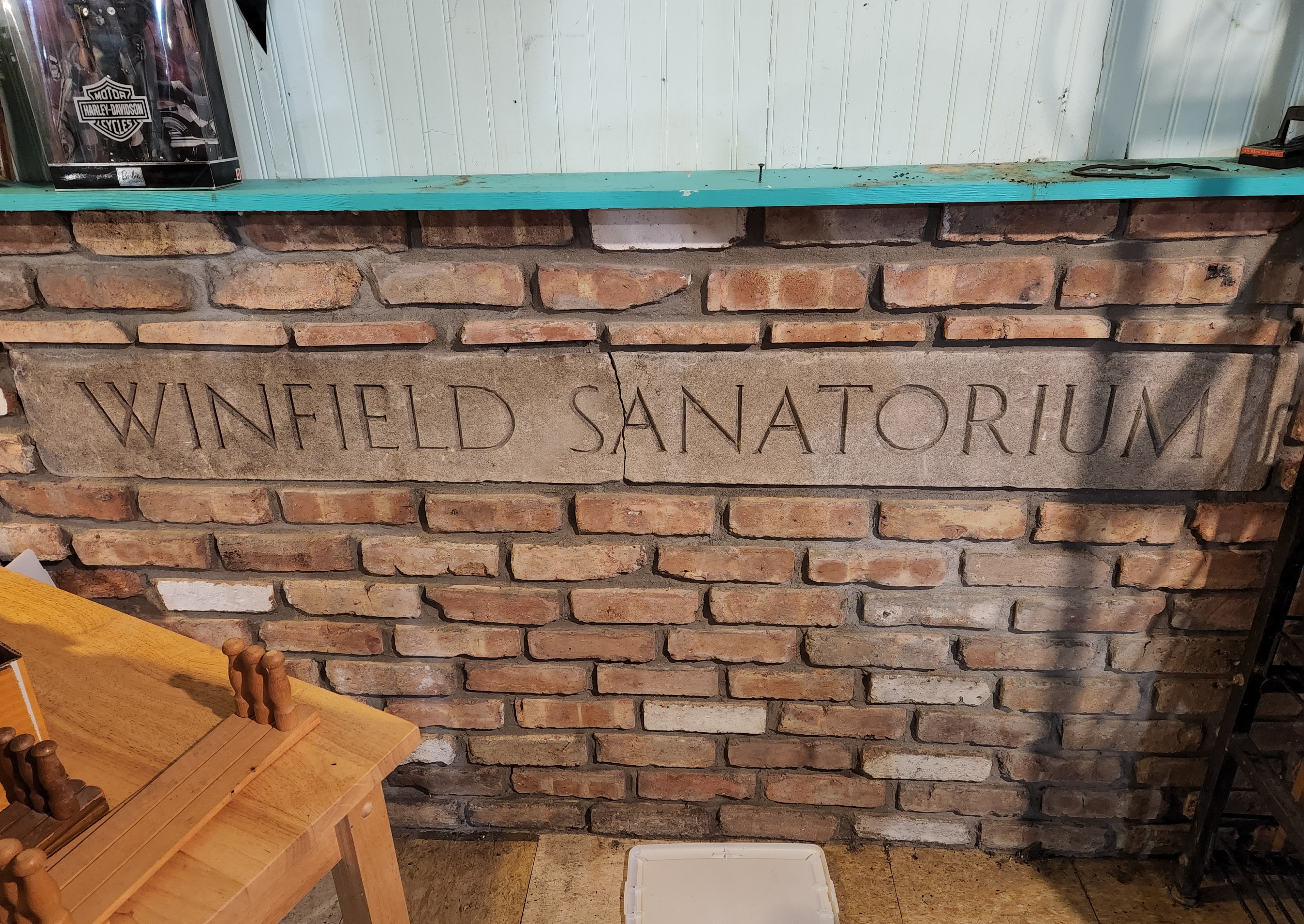
This past weekend my wife and I stopped by an estate sale held on Park Street near the Winfield Elementary School. Much to our surprise while in the basement of the home at 0S185 Park St in Winfield we spotted this sign in the photo below:

If anyone out there may have any information on how this sign was built into the foundation of this home please reach to me so that I can record as the late great WGN-TV radio personality Paul Harvey used to say, “The Rest of the Story!”.

The Winfield Tuberculosis (TB) Sanatorium was once located on the property now occupied by Central Dupage Northwestern Hospital. According to the Chicago Tribune and Louise Spanke’s book Winfield Good Old Days: A History:

The gleaming and modern Central DuPage Hospital, which sits atop a hill in Winfield overlooking the DuPage River, had its beginnings as a two-story frame building opened in 1897 by Jessie P. Forsythe as a rest home. She operated it with her sister Christine.

According to Louise Spanke in her book “Winfield’s Good Old Days, A History,” the two women employed a rest-cure system that incorporated primarily rest and massage. In 1908, a year after her sister died, Jessie Forsythe sold the rest home. [This is the Rest Home where my Great-Grandmother Susan Schlick once worked and lived for a period of time. See this post for more on story.]

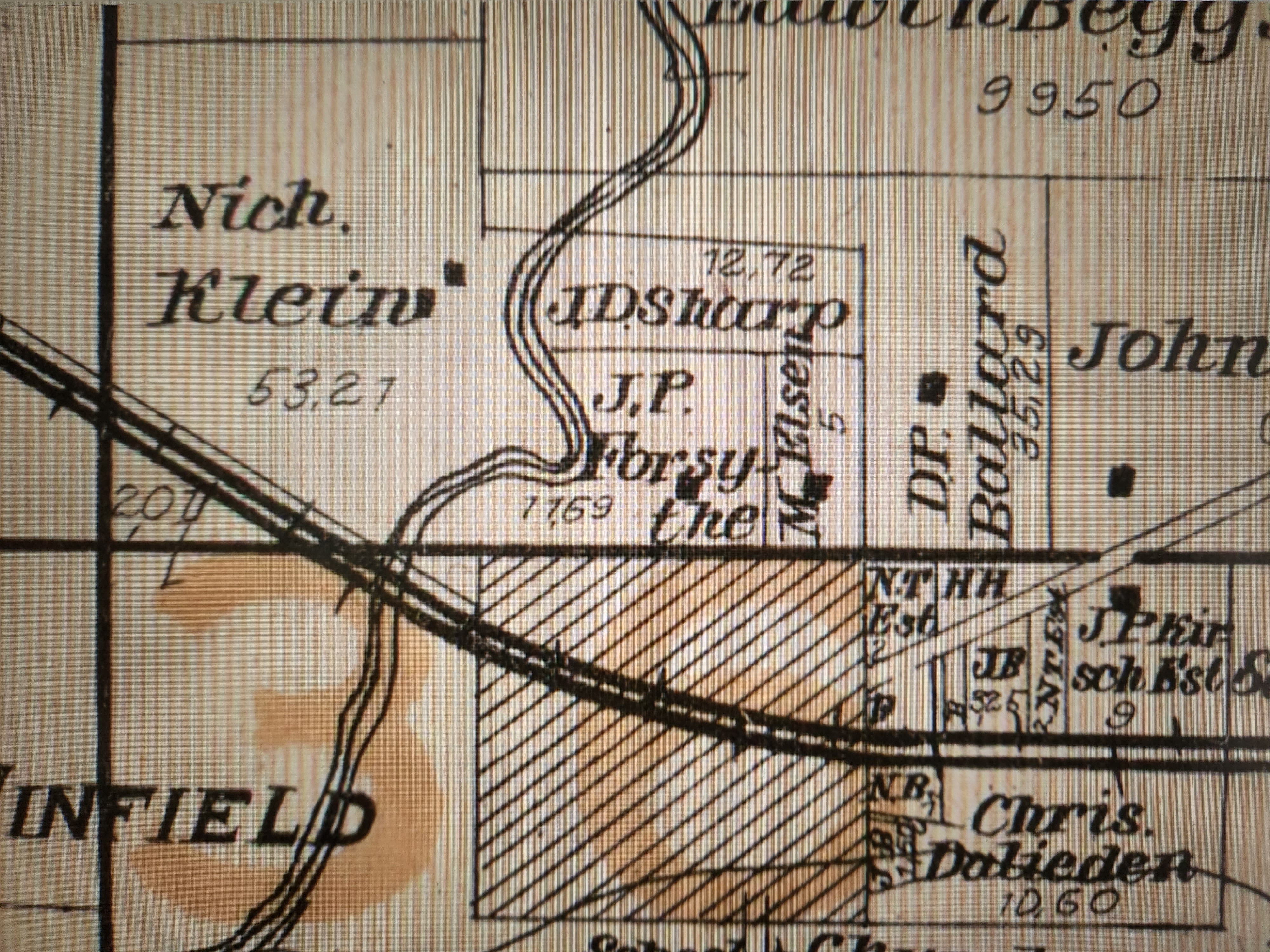
A 1904 plat map for Winfield Township shows where the Forsythe Rest Home was located north of the Village of Winfield.

The 5 July 1907 issue of the Wheaton Illinoian recorded the following: Mrs. Marion Ashley had been appointed manager of the Winfield Rest Farm. Miss J.P. Forsythe, the owner, has taken charge of her sister’s rest home in Chicago. The sister having died a few weeks ago.

In 1909, the Chicago-Winfield Tuberculosis Sanatorium opened a sprawling facility at the site. It was run by three societies-the Baron Hirsch Woman’s Club, the Jewish Consumption Relief Society and the Willing Workers. The sanitarium eventually purchased more of the surrounding land.

In 1962, as more and more treatment for tuberculosis was being handled by places like Michael Reese Hospital in Chicago, the sanitorium closed and sold its property to an association of citizens that was seeking to open a hospital for the area.

The purchase price was $1.1 million, and another $1.5 million was spent on improvements. In 1964, the hospital opened as a 113-bed, acute-care facility with a staff of 95. 

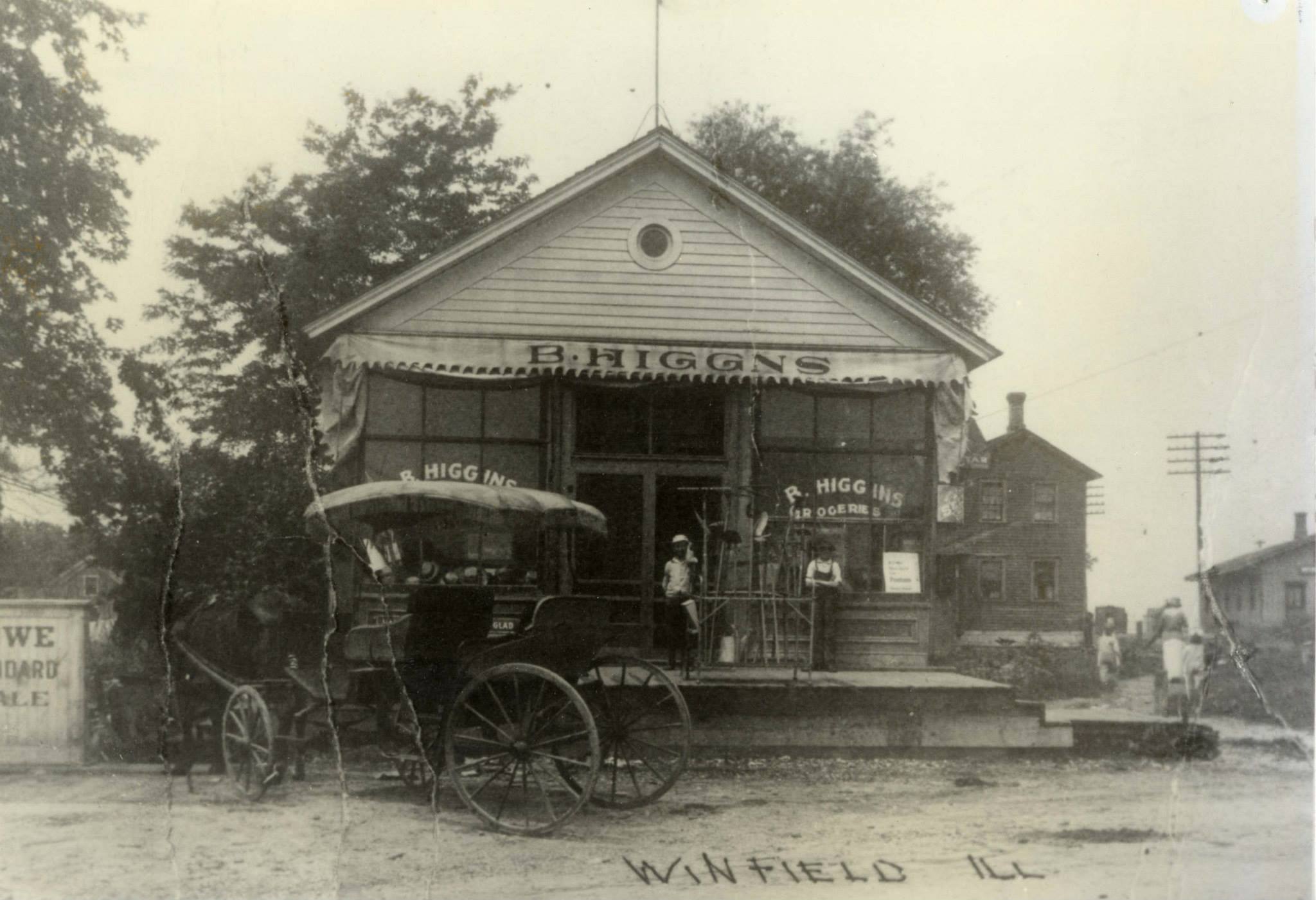
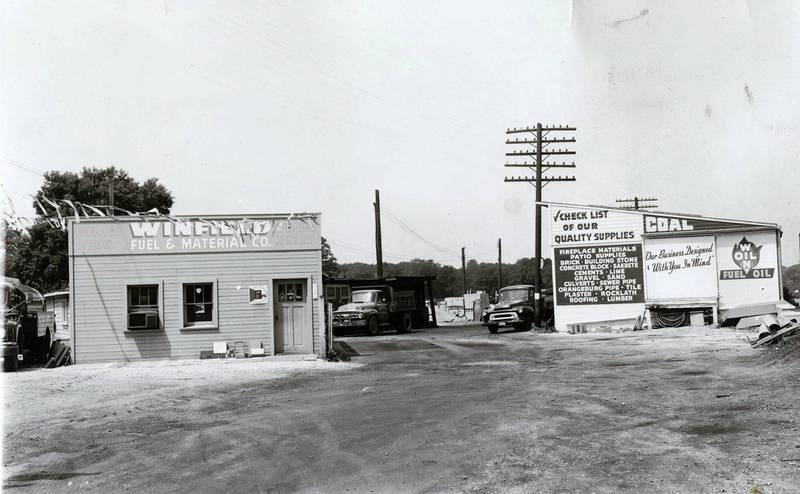
Via the Internet I found out that the home on Park Street was once owned by Thomas W. Saylor, Sr. Thomas married Laurene Higgins. Laurene was related to the family that ran the Higgins Store in Winfield. Higgins Store was well known to Winfield and area residents and was in operation for decades. Thomas Saylor, Sr. was the owner and operator of the Winfield Fuel and Material Co. The Fuel and Material Co. were in business for 118 years. The Higgins family at one time owned and operated the Winfield Fuel and Material Co. The land once occupied by the Winfield Fuel Co. is now occupied by a large multistory Winfield Station Apartment complex.

The serendipity and discovery of history research never ceases to amaze me. This is what keeps me going during my retirement. At first I did not want to go to this Estate Sale but my wife encouraged me to “Let’s just go and take a look“. I am so glad I did. The estate sale uncovered a lost remnants of Winfield’s history.

Posted in Uncategorized, Winfield History | 2 Comments

German Immigration to America: Historical Context to the Voyage Part 2

In the first part of this blog series we reviewed a German immigrant’s voyage from Europe to New York City. In this second part we will review what happened to immigrants once they reached the port of New York.

Castle Garden was New York’s first immigration station. The station welcomed over 8 million immgrants between 1855 and 1891. This station was located on the southern tip of Manhattan Island. In 1855 it became the first Emigrant Landing Depot in the United States. Ellis Island became the new immigrant processing center on January 2, 1892 when Castle Island closed.

On the 7th of December 1857, the Daleidens walked down the board walk from their sailing ship, the E.C. Scranton, to enter the Castle Garden building, where the immigration officials processed them for entry into the country. They were on American soil.

The Daleidens were among 268 passengers on board the Scranton. The ship’s captains gave custom official a manifest listing of all the passengers. The lists were very simple in terms of the information provided for each passenger: name, age, sex, occupation, place of origin and final destination for each passenger was listed. The Daleiden name was spelled: “Dahleiden“. Daleidens listed on this List include: Christoph (my great great grandfather) 20 years of age, his father Mathias 53, his brother Peter 17, and his two sisters both named Barbara were 22 and 13. Christopher and his father list their occupations as “farmers”. They list “Prussia” as their nation of origin and their destination as Illinois.

The 17 October 1856 Passenger List showing Michael Daleiden’s arrival to American aboard the David Hoadly.

Missing from this list was Michael Daleiden. Michael arrived on the 17th of October 1856 on the sailing ship the David Hoadly. Michael is listed as 18 years of age. Michael was amongst a total of 161 passengers on board the Hoadly. The two ships carrying the Daleidens sailed from the Port of Antwerp.

An illustration of the sailing ship the E.C. Scranton that carried the Daleidens to American.

Finding Michael on this passenger list was important. We have a document in our hands that shows Michael Daleiden was in America on a certain date with the remainder of his familying following him a little over a year later in 1857.

How did the family get to American and how did they get to Chicago and to Winfield Township in Dupage County Illinois. While I do not have any letters nor diaries documenting the trip I was able to locate several family histories via the Family Search website and the LDS Library in Salt Lake City Utah.

One genealogy titled: Lies Family Centennial and Re-Union: Centennial of Anna Neu Lies and John Lies in America (1952). The Lies immigrated to America in 1852 and settled in the Aurora, Illinois area. They have a familial connection to a Daleiden family of the City of Aurora. They embarked from the same port as the Daleidens, the Port of Antwerp. In the published Lies Family Genealogy there is a narrative of their trip from their home of Haller in Germany. I suspect that the Daleidens had taken a similar route. Here is a list of the Lies journey and how they arrived to Chicago and the State of Illinois:

Started out from Haller “Covered wagon style”.

-Arrived in Hosingen to stop over for the first night

Second day the Lies family reached Pepinster, Belgium, the nearest railroad station. They then traveled by rail to Antwerp.

They set sail for twenty days for the trans-Atlantic journey in a three mast sailing ship similar to the Daleidens.

They finally sighted the American shore in the distance.

Their ship was anchored off shore for two days off Staten Island for inspection.

Transported via tug boat to New York.

River steamer up the Hudson River to Albany New York and stayed at the Stienmetz Hotel.

Next day, they went via Railroad to Buffalo New York.

Proceded by boat to Detriot Michigan

Then via Railroad to Chicago.

I now at this point have a gap and questions as to where Michael and the family were for roughly seven years and eight months between the dates and years: 17 October 1856 and 4th May 1864. We have Michael’s Passenger List of 1856. We have a Deed document showing the purchase of 40 acres of land in Winfield Township in DuPage County Illinois in 1864. I will need to spend more time digging to find their whereabouts.

Finally, I would like to acknowledge the work of Steve Szabados and his book German Immigration to America: When, Why, How, and Where. I liked this book and have quoted extensively from his work in this blog and in part one of this blog. Thanks!

Posted in Christopher Daleiden, Daleidens, Genealogy Sources, German Immigration History, Michael Daleiden, Uncategorized | Leave a comment

Memorial Day 2022: Honoring Davis Family Members Who Are Serving or Have Served. Featuring: George G. Davis World War I Service.

On this Memorial Day weekend 2022 I would like to salute family members who proudly served in the military whether that be during war, peacetime draft, or served as Reservist out of their sense of duty.

In my family research so far I have not uncovered any Daleiden relative serving in the military during any past wars or conflicts. I will need to do some more research.

We have several that served during peace time drafts. My father George Davis served in a U.S. Missile Battalion Unit in Germany in the late 1950s during the Cold War.

George Stuart Davis my father served in Germany in a U.S. Army Missile Battalion during the late 1950’s.

James Weberpal who’s served in Germany during the peace time draft. Jame’s mother was Rose Schlick the daughter or Joseph Schlick of Burlington in Kane County Illinois. James or “Jimmy” past away this spring. He was an excellent source of Schlick family history.

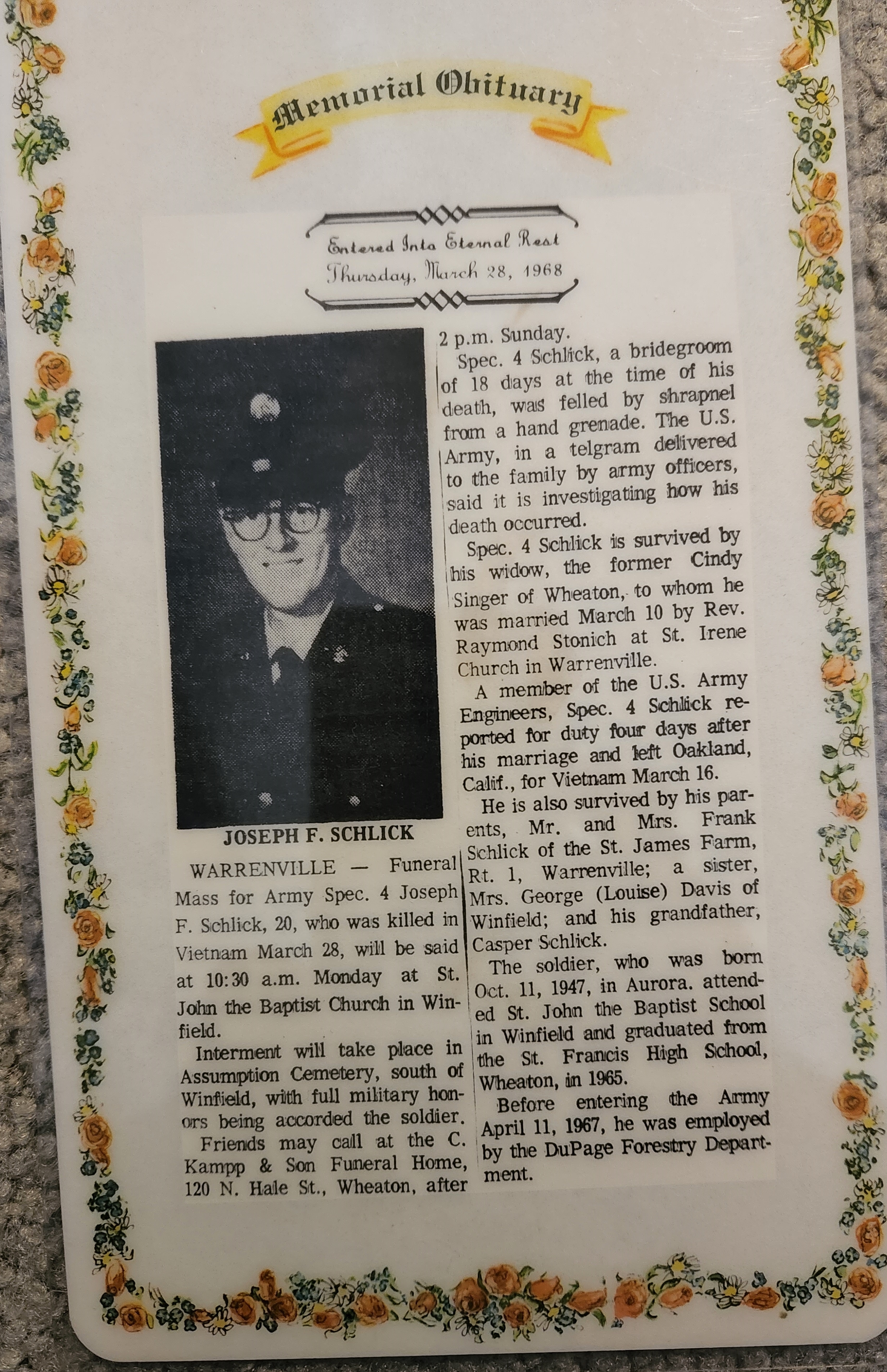
My uncle, Joseph Schlick served and gave his life during the Vietnam War. Here is is obituary from the Wheaton Illinois Daily Journal.

Joseph Francis Schlick (1947 – 1968). Served in U.S. Army Engineer Specialist 4 in Biên Hòa, Đồng Nai, in Vietnam.

My daughter Caroline Davis is currently a Naval Reservist serving as a Master of Arms. She recently completed her deployment in Africa. I am very proud of her that she decided to take a portion of her life to provide service to our country! She has never been a selfish person and always thinking of ways to help people.

My Grandfather George Germaine Davis served in World War 1. George was born and lived in the City of Chicago his entire life. He worked for several railroads in the railyards near the Union Stock Yards on Chicago’s Southside. He was nicknamed “Boomer” Davis. In railroad slang a “Boomer” was a
. . . Drifter who went from one railroad job to another, staying but a short time on each job or each road. This term dates back to pioneer days when men followed boom camps. The opposite is home guard. Boomers should not be confused with tramps, although they occasionally became tramps. Boomers were railroad workers often in big demand because of their wide experience, sometimes blackballed because their tenure of stay was uncertain. Their common practice was to follow the “rushes”-that is, to apply for seasonal jobs when and where they were most needed, when the movement of strawberry crops, watermelons, grain, etc., was making the railroads temporarily short-handed. There are virtually no boomers in North America today. When men are needed for seasonal jobs they are called from the extra board. (Source: Freeman H. Hubbard. Railroad Avenue: Great Stories and Legends of American Railroading. McGraw-Hill Book Company, 1945).

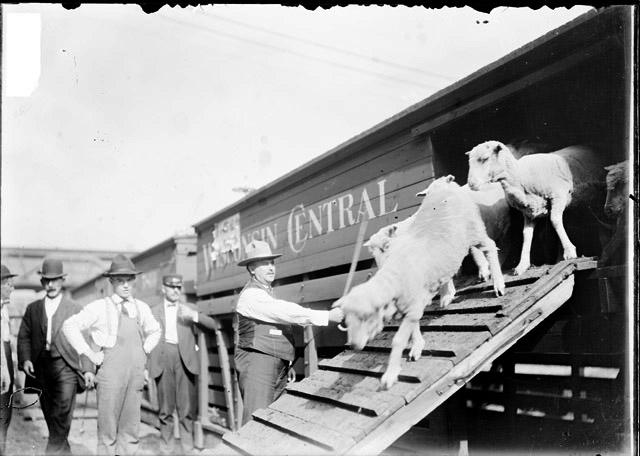
Union Stock Yards Chicago Illinois. This photo shows sheep being lead out of a railway box car that carried them from the western states to be ready to be made into food products. George Davis worked in the railyard coupling trains together. (Image: Chicago Daily News Photos Courtesy of the Chicago History Museum).

George was primarily known as a “humper“. In railroad slang a “hump” was a small rise used to assist in coupling train cars in a yard. A humper was someone who assisted box cars to be connected to one annother through the use of a hump. It was very dangerous work.

Later in life due to various health issues he worked as a Cabby for the Chicago Yellow Cab Co. George and his life partner Florence Brose Adelsperger raised two children: George S. (my father) and Suzanne Davis. Grandmother Adelsperger had one child with her husband Robert Adelsperger. His name was Dr. Robert Adelsperger, Jr., my father’s half-brother. Robert or “Bob” became a rare book librarian and started the Special Collections Department for the University of Illinois at Chicago campus.

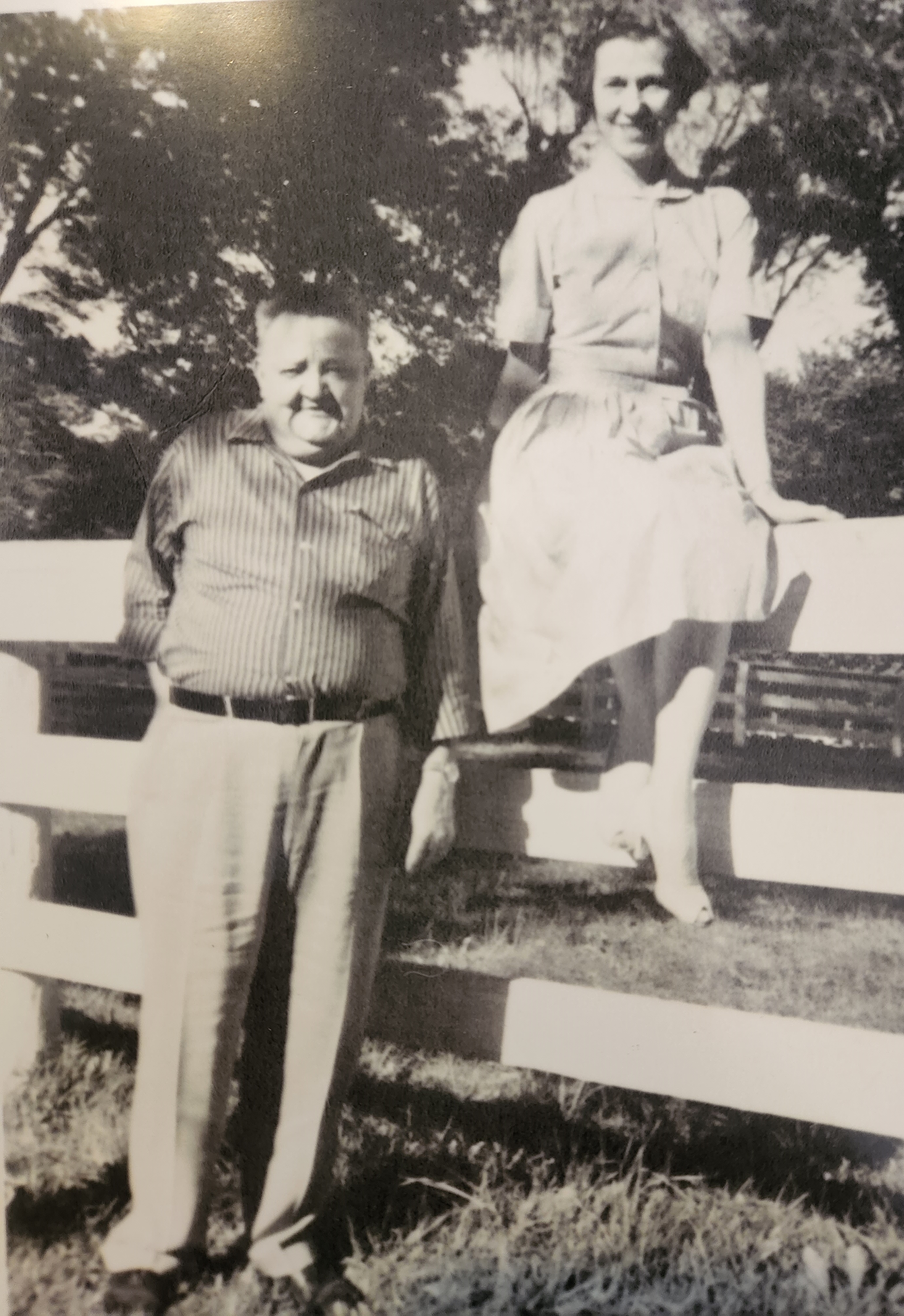
George G. Davis and Florence Brose Adelsperger, my paternal grandparents. This photo was taken at St. James Farm near Warrenville Illinois in the late 1950s. St James is where my mother lived for a short period of time with her parents Frank J. and Mae C. Schlick and her brother Joseph F. Schlick from mid 1950s to late 1950s.
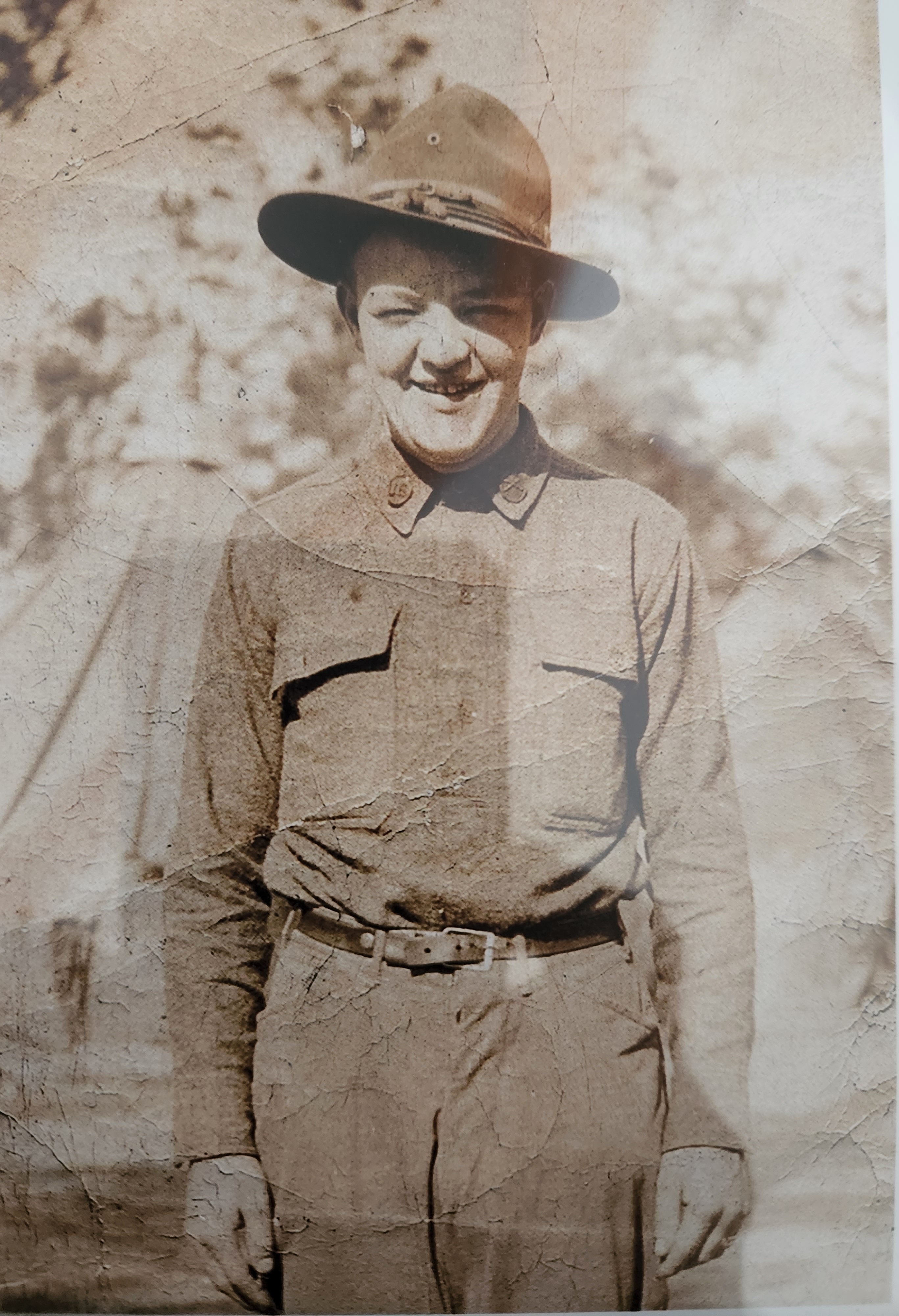
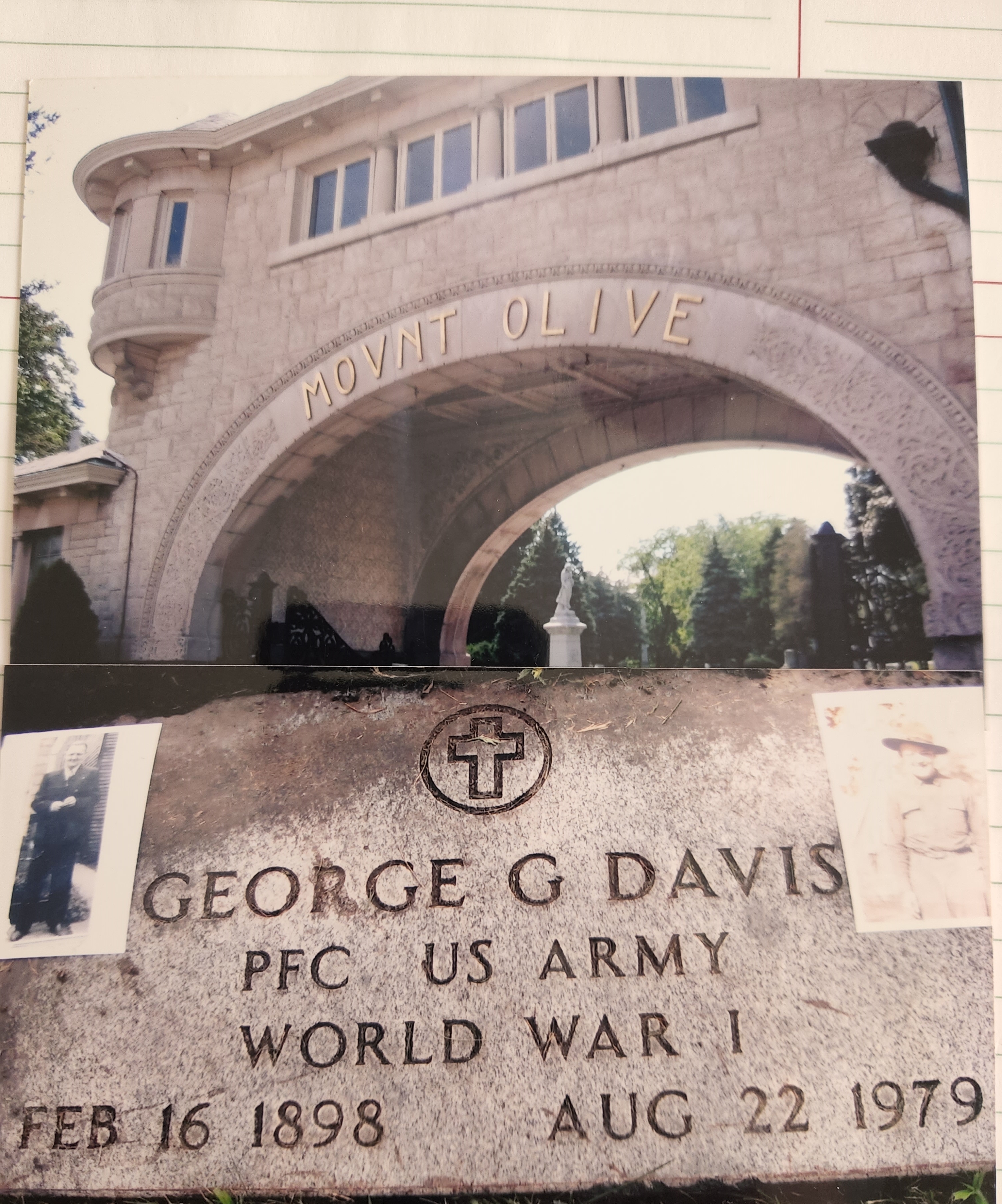
George Germaine Davis (1898- 1979). Davis served his country in Europe during World War I and saw action in the Meuse–Argonne offensive that took place from September 26, 1918, until the Armistice of November 11, 1918. He assisted with the horses that pulled the artillary cassions to the front.
George G. Davis, my Grandfather, is buried at Mount Olive Cemetery in Chicago.

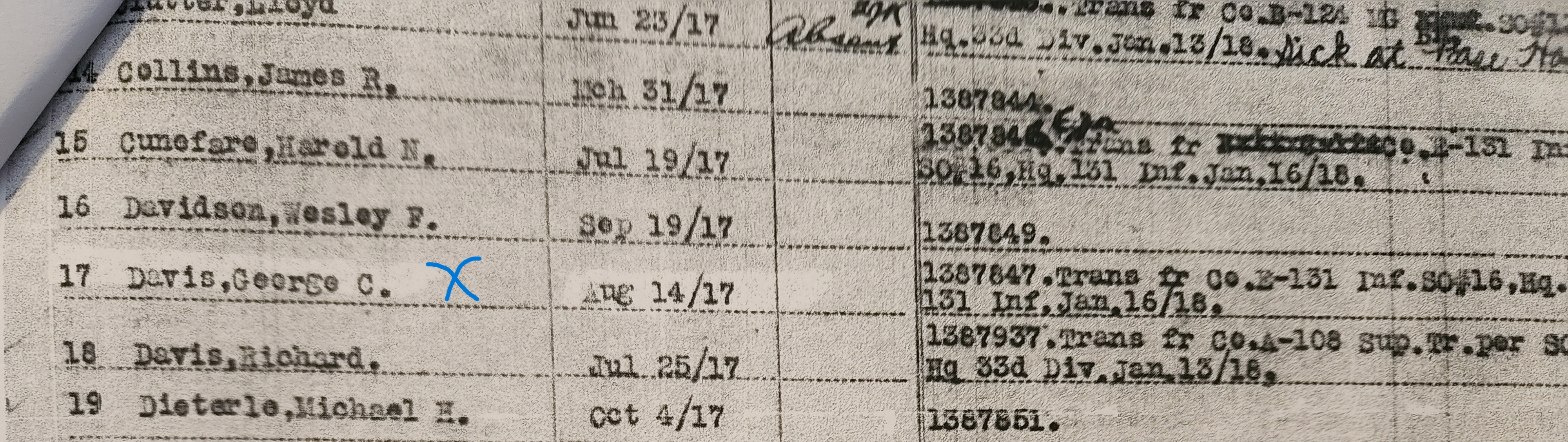
Doughboy” Private 1st Class George G. Davis was part of the First Infantry of the Illinois National Guard reorganized as part of the 33rd Division 131st U.S. Infantry Regiment Company H. He served from the time of his draft 14 August 1917 to 15 June 1919. In an oral history interview with my father George S. Davis I was informed that Grandpa Davis’ main charge and title was that of a Teamster during the war “driving” the artillary cassion wagons pulled by horses to the frontlines.

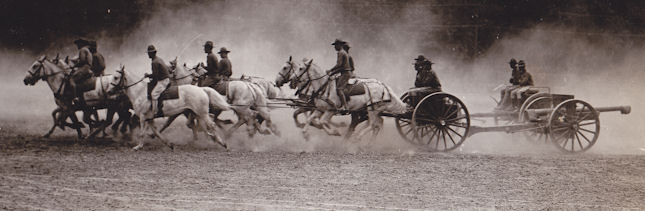
The abvoe photo shows a 75mm mle/97 section from Battery “C”, 16th Field Artillery at Fort Myer, VA in 1927. George Davis was helping to take care of the horses and also driving the cassions to the front in a similar situation from 1918 – 1919.
Photo source: Lovett Artillary website.

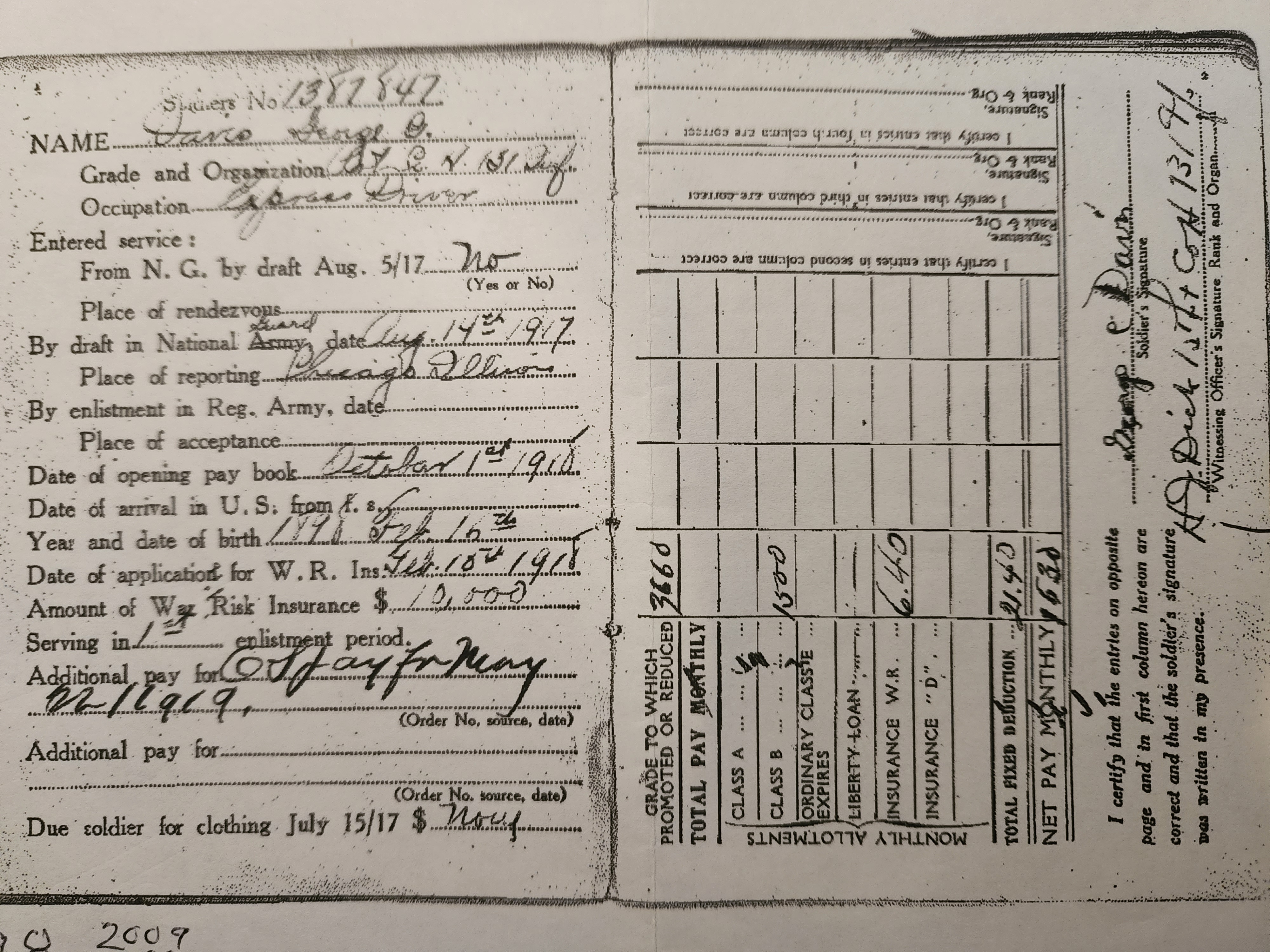
George G. Davis’s World War I Pay Book. This document was from my father’s personal papers. This type of document is a good information source for genealogists. A Pay Book provides a lot of personal information as well: the date of birth and home city.
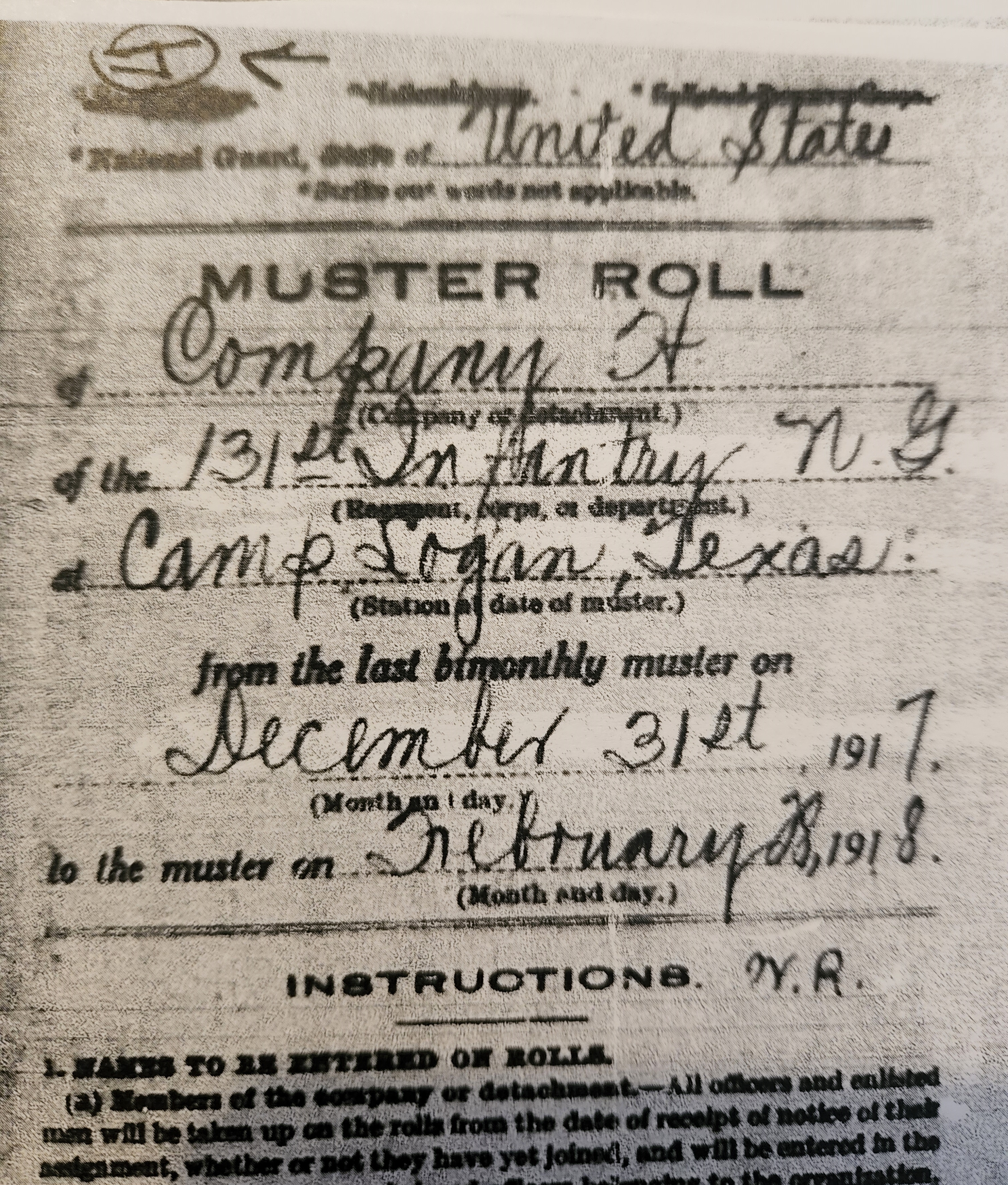
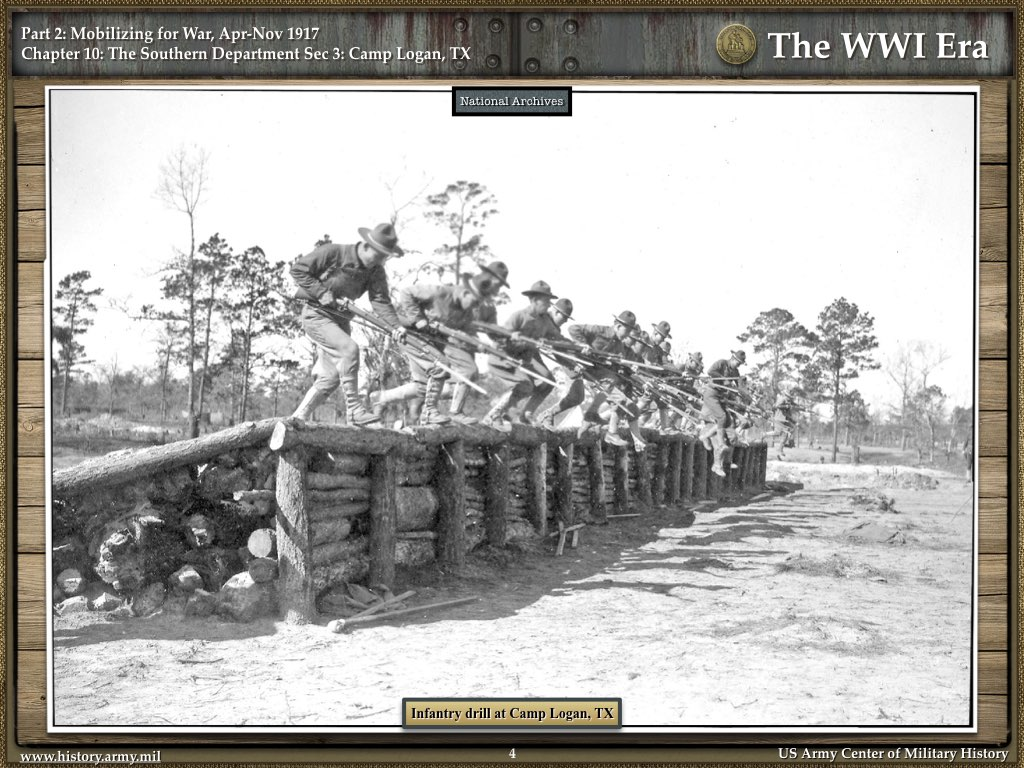
Muster Roll cover page for 28 February 1918. This Muster was taken at Camp Logan Texas. This is where George Davis was stationed for training. (Document is from the National Archives Personnel Records Service in St. Louis Missouri).

This is one of the pages of the above Muster Roll. This shows George Davis at Camp Logan in Texas. The Muster Roll was used by the U.S. Army to track soliders and their status at a given point of time. The Roll shows his serial number and his transfer from the Co. E 131st Division. This is another rich source of information for genealogists wanting to track their solider during a war. (Document from National Archives Pesonnel Record Service in St. Louis Missouri).
Camp Logan Texas U.S. Army Training Camp. (Photo Courtesy: U.S. Army Center of Militray History).
Posted in George G. Davis, George S. Davis, Uncategorized | 1 Comment

Genealogy Sources for Research: Handout from May 17th Daleiden Schlick Program

Genealogical Sources

Daleiden and Schlick Family History in Winfield

Winfield Library and Winfield Historical Society Program Tuesday, May 17, 2022

Internet Sources:

Ancestry: ancestry.com. Subscription.May also be available through your local public library.

Family Search:familysearch.org. Free online. Church of Jesus Christ of Latter Days Saints.

Illinois Digital Archives: idaillinois.org. Free online.

The Illinois Digital Archives contains scanned pdf file editions of local history books, maps, atlases, newspapers, documents, and photographs submitted by State and local archives, libraries, and historical societies.

United States National Archives and U.S. Regional Archives: archives.gov/research/genealogy.

Excellent resource and starting point for family historians on U.S. Government sources                       for genealogists (Census, Immigration, Military, Land, etc.). Includes downloadable and    printable worksheets.

Books:

Rufus Blanchard. History of DuPage County Illinois. O.L. Baskin & Co. Historical              Publishers.1882.

Encyclopedia of Chicago. University of Chicago. 2004.

[A web version of this book is available for free at: encyclopedia.chicagohistory.org].

Historical Encyclopedia of Illinois and History of DuPage County. Edited by Newton Bateman                      and Paul Selby. Munsell Publishing Co. 1913. [Two Volumes. This is perfect example of      a “Mug Book”].

Mildred Knoblauch. DuPage County: A Descriptive and Historical Guide 1831 – 1939. Irvin A.             Ruby Distributor. 1948.[American Guide Series Federal Writer’s Project of the Works                Progress Administration].

James McGuire. Images of America: Winfield. Arcadia Publishers. 2017.

Jean Moore. A History of Wheaton, Illinois: From Tower to Tower. Gary-Wheaton Bank. 1974.

Leone Schmidt. In and Around Historic Warrenville. Warrenville Historical Society. 1982.

Leone Schmidt. The Life and Times of Warrenville. City Council of Warrenville Illinois. 1975

Frank Scobey. A Random Review of West Chicago History. West Chicago Historical Society.           1976.

Louise Spanke. Winfield’s Good Old Days: A History. Winfield Public Library Board. 1978.

Maps and Atlases.

1862 Map of DuPage County. Reprints available for $15 on paper. DuPage County Historical         Society Museum/Wheaton Park District.

1874 Atlas of DuPage County Illinois. Available on IDA website and at Wheaton Public Library.

1904 Atlas of DuPage County Illinois. Available on IDA website and at Wheaton Public Library.

United State Decennial Census Records 1790 to 1950.

Available on Ancestry, Family Search, and the National Archives Website.

Birth, Death, and Probate Records.

DuPage County Court House Clerks Office. For an index to birth, marriage, military records consult the Illinois State Archives at: ilsos.gov/departments/archives/gen_research.html.

Real Estate, Land and Property Tax Roll Records.

            Consult the DuPage County Assessors: dupagecounty.gov/PropertyMenu.aspx

and DuPage County Tax History site: dupagecounty.gov/CountyClerk/TaxHistorySearch/

Naturalization Records.

            Consult with the DuPage County Clerks Office in Wheaton. Review and look at the DuPage County Genealogical Society’s publication: Index to the Naturalization Records of DuPage County Illinois. This is available at the Wheaton Public Library and may be available at your local Public Library in your town in DuPage County.

Newspapers.

            Check with your local Public, College, or University Library for print, electronic or microfilmed copies of newspapers from the nineteenth and twentieth centuries.

Passenger Lists and Immigration Records.

            Ancestry and Family Search have scanned copies of ship passenger lists.

DuPage County Genealogy Society. (Website: dcgs.org)

            Join this Society and have access online to many resources if you have relatives that lived (or passed through) DuPage County Illinois. They have a bi-annual Journal and a monthly e-newsletter. The Society hosts in-person and virtual webinars.

Daleiden Direct Family Line:

Johann Daleiden / Ann Giltzemer

Johann Daleiden (1766 – 1870)/Barbara Theil (1779 -?)

Matthias Daleiden (1804-1870) / Anna Marie Scheurer (1799 – 1855)

Katerina 1828

Barbara K 1834

Michael 1835

Christopher 1836

Peter 1840

Barbara (1843-1887)

Christopher Daleiden (1836-1910) / Margaret Weiland (1839-1916)

Barbara 1870

William 1872

Anna 1875

Susan 1877

Katherine 1880

Casper Schlick (1878-1970) /Susan Daleiden (1877-1945)

Francis ‘Frank’ Schlick (1910–1993) / Mae Hodous (1911-1989)

George S. Davis (1934-2020) / Louise Schlick (1936-1994)

G. Kevin Davis

Posted in Christopher Daleiden, Daleidens, Genealogy Sources, Uncategorized, Winfield History | Leave a comment

Daleiden / Schlick Family and Winfield Illinois History Lecture Winfield Library Tuesday May 17 2022

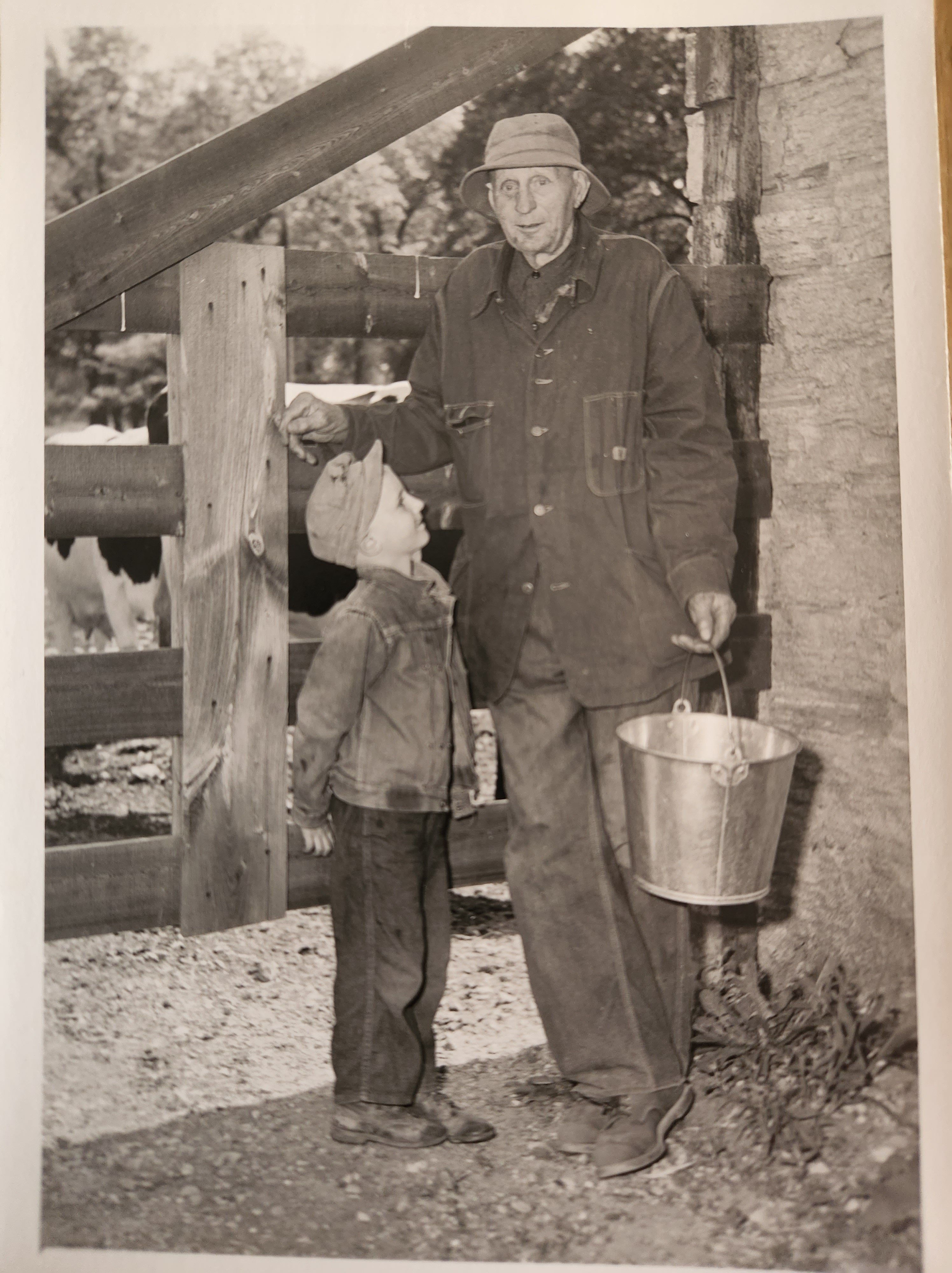
In the spirit of Norman Rockwell this photo is posted. Casper Schlick and his Grandson Fred Schlick on the Daleiden/Schlick Farm located on Mack Road in Winfield Township. The farm is now a part of the Blackwell Forest Preserve of the DuPage County Forest Preserve District. The farm was sold to the District in 1967 and became a part of the District in 1970 upon the passing of Casper in 1970. Casper lived and farmed on the property for sixty years (60). (Photo Credit: Frank J. and Mae C. Schlick Estate Photo Archive).

I presented over 40 years of my own genealogy research on the Schlick and Daleiden Families of Winfield Illinois.

The lecture took place at the Winfield Public Library (0s291 Winfield Rd, Winfield, IL 60190) on Tuesday, May 17th at 7:30 p.m. The program was co-sponsored by the Winfield Historical Society.

Here is the recorded program link via Zoom.

Posted in Uncategorized | Leave a comment

Matthias and Christopher Daleiden’s Naturalization Papers 1856.

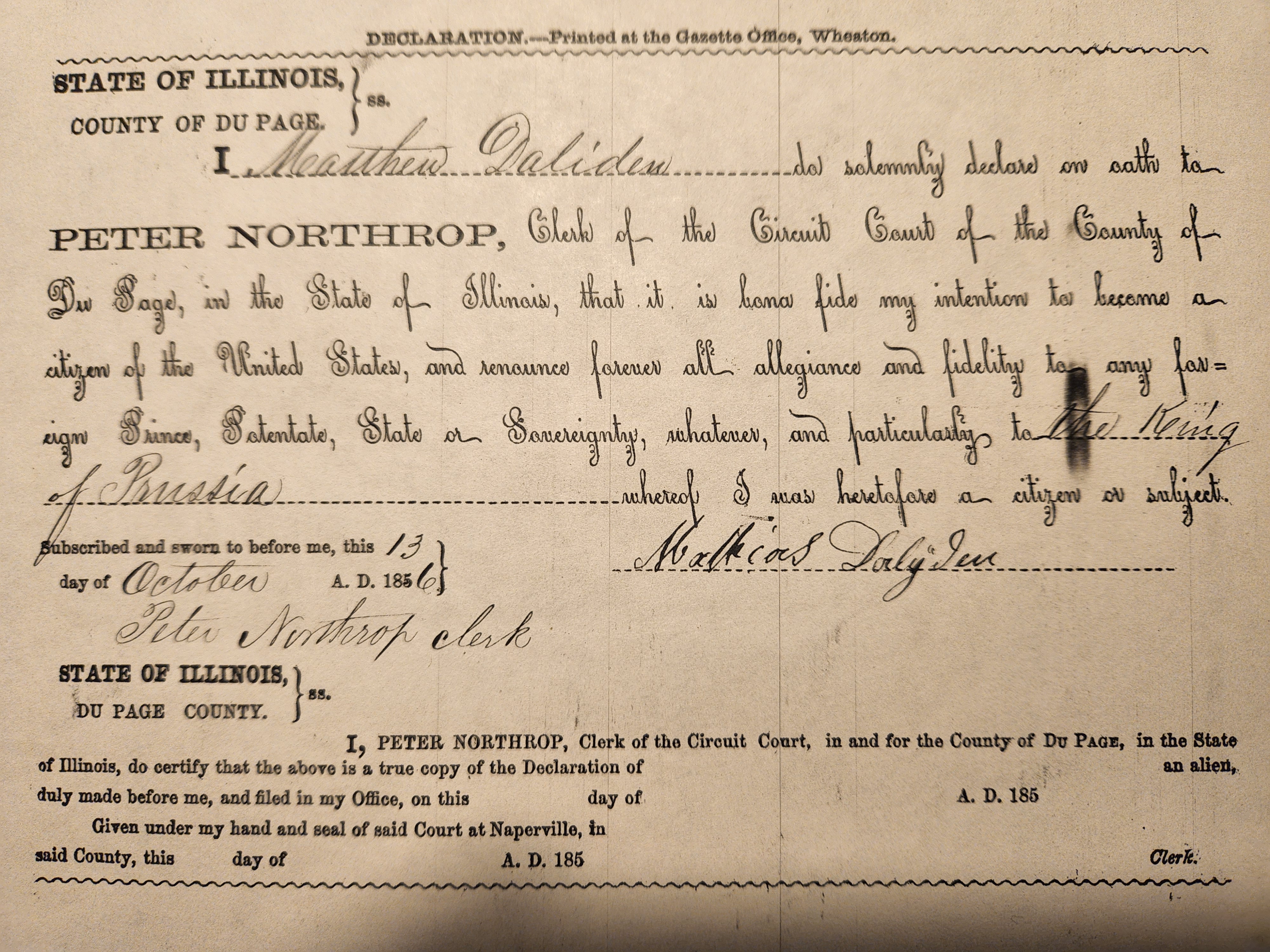
Matthias Daleiden’s “Declaration of Intent” to File Naturalization Papers”. (Source; DuPage County Clerk’s Office, Naturalization Files. Matthias Daleiden. 1856).

The above document from the DuPage County Clerks office show Matthias Daleiden’s signature on a Declaration of Intent to file Naturalization Papers. The date of filing was on 13 October 1856. Shows him announcing his renunciation  of affiliation with the Prussian King. Matthias was the father of Christopher and Michael Daleiden. He was the patriarchal head of the Daleiden family.

Naturalization was a two-step process. First, a declaration of intention to become a citizen would be filed in any court of record. This step is labeled “Declaration” and is sometimes referred to as “first papers.”

After a waiting period of a set number of years, which varied depending upon the statutes in effect at the time, the potential citizen would file a petition, forswear allegiance to the United States. This second step often called “final papers” likewise could be filed in any court of record. There were residency requirements [in Illinois it was a five year period of residency with one year residing in the United States], which varied, but the two steps did not have to be, and often were not, performed in the same court.

There were exceptions to the first step. Men who had entered the country as minors were able to peition directly upon reaching teh age of 21. At various times the declaration was waived for soldiers and for alien wives of citizens.

A Declaration of Intent could be invalidated. Thus a candidate may have filed more than one declaration. Not all applicants who filed first paper necessarily followed through with the final papers in the same court, or at all. It is entirely possible to find two or more declarations of intent for the same individual, yet no petition.

Likewise a petition could be invalidated and mutiple petitions may be recorded using one or more declarations.

No doubt a certificate was issued to the new citizen from the earliest days. It was not until 1900, however, that DuPage (County in Illinois) Circuit Court recorded teh issuance of these Certificates of Citizenship by number and retained a copy. Issuing a certificate was the culmination of the petition phase. In early days it was issued on the day the applicant peitioned the court; later there was a delay of a few weeks. More recent naturalizations typically had a six-month span between petition and certificate dates. Factors could delay the certificate even longer, particularly during wartime.

(Source of the above paragraphs were excerpted from: Index to the Naturalization Records of DuPage County, Illinois. DuPage Co. (IL) Genealogical Society. Wheaton, Illinois. 2006. This book is able in several DuPage County Illinois Public and College Libraries. It indexed by name of Naturalization records filed from 1872 to 1906).

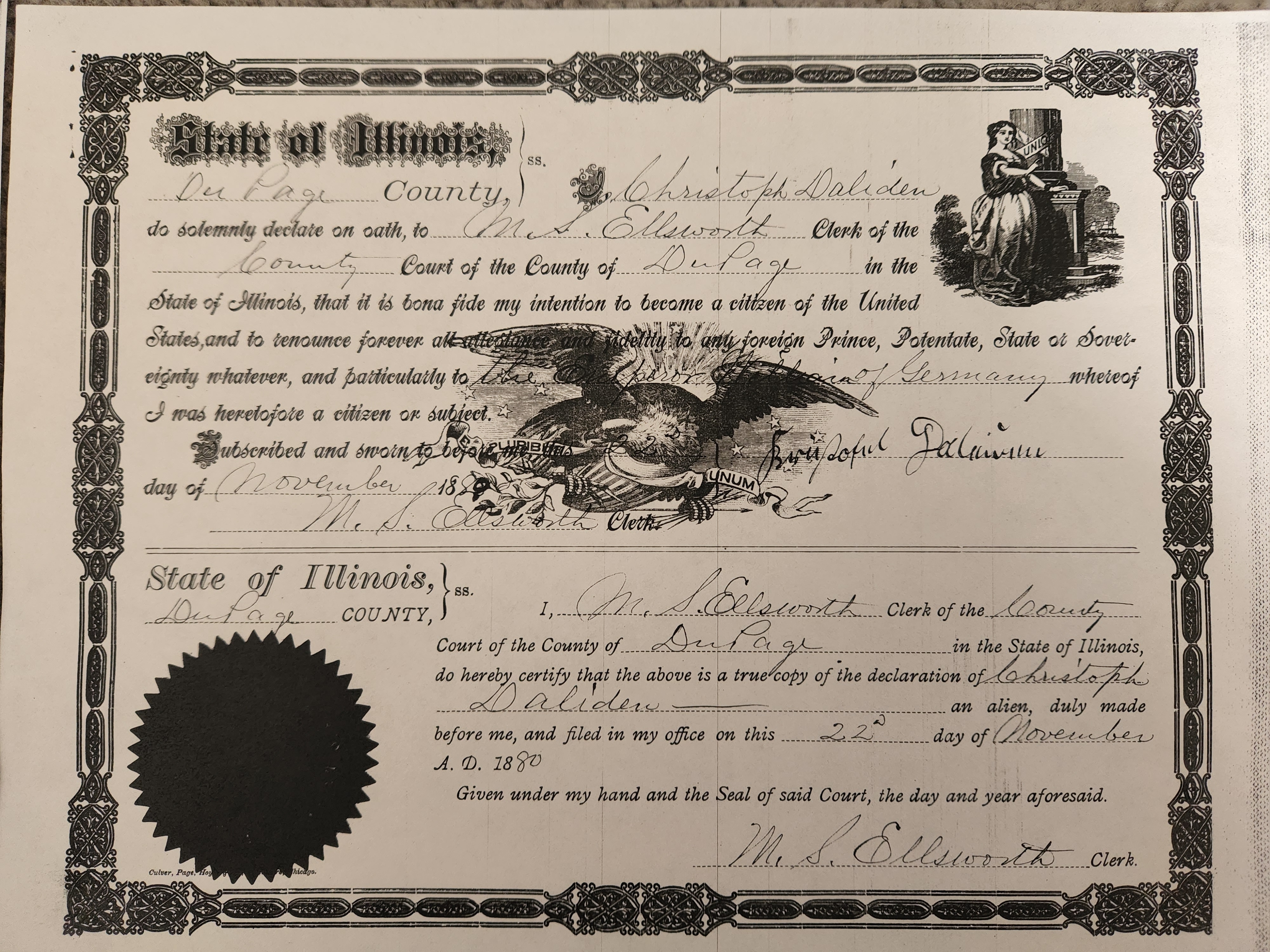
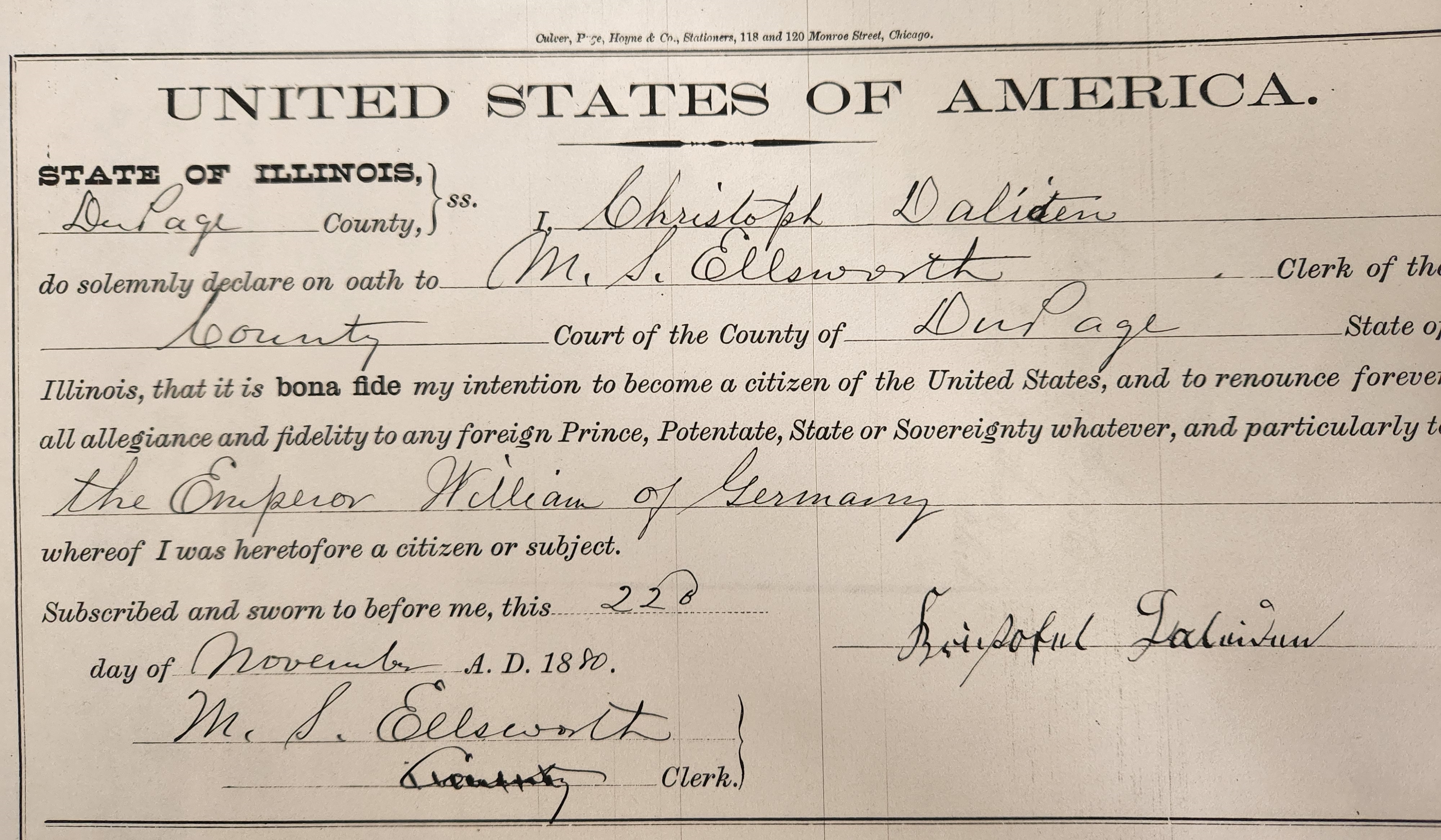
Certificate of Naturalization dated 22 November 1880 signed by Christopher Daleiden. Christopher was this blogger’s Great Great Grandfather.
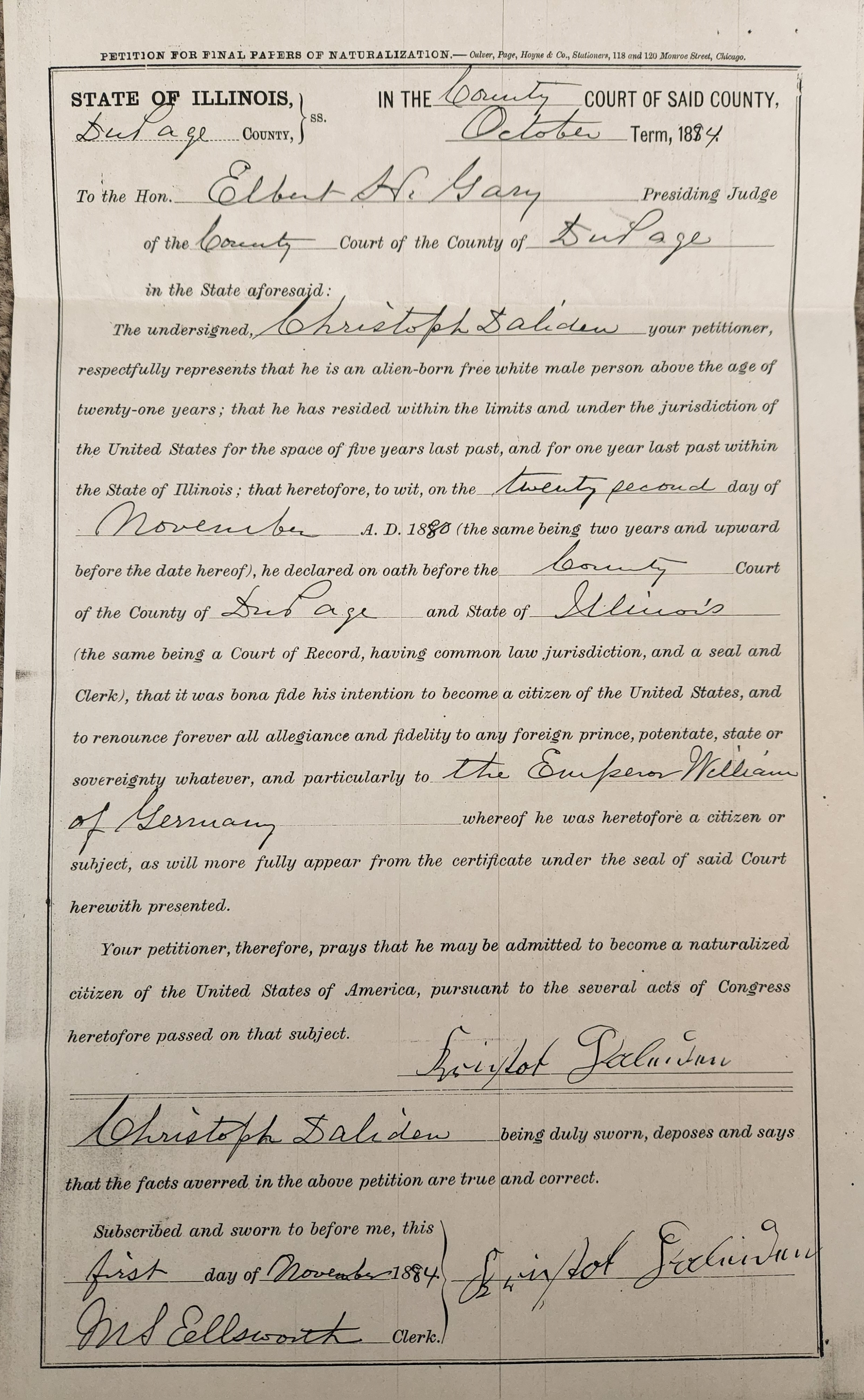
Petition of Final Papers for Narturalization dated 1 November 1884 for Christopher Daleiden. Note the name of Judge Elbert Gary. Judge Gary would later become the Mayor of the City of Wheaton and the President of the United States Steel Corporation. The City of Gary Indiana is name after Elbert Gary.
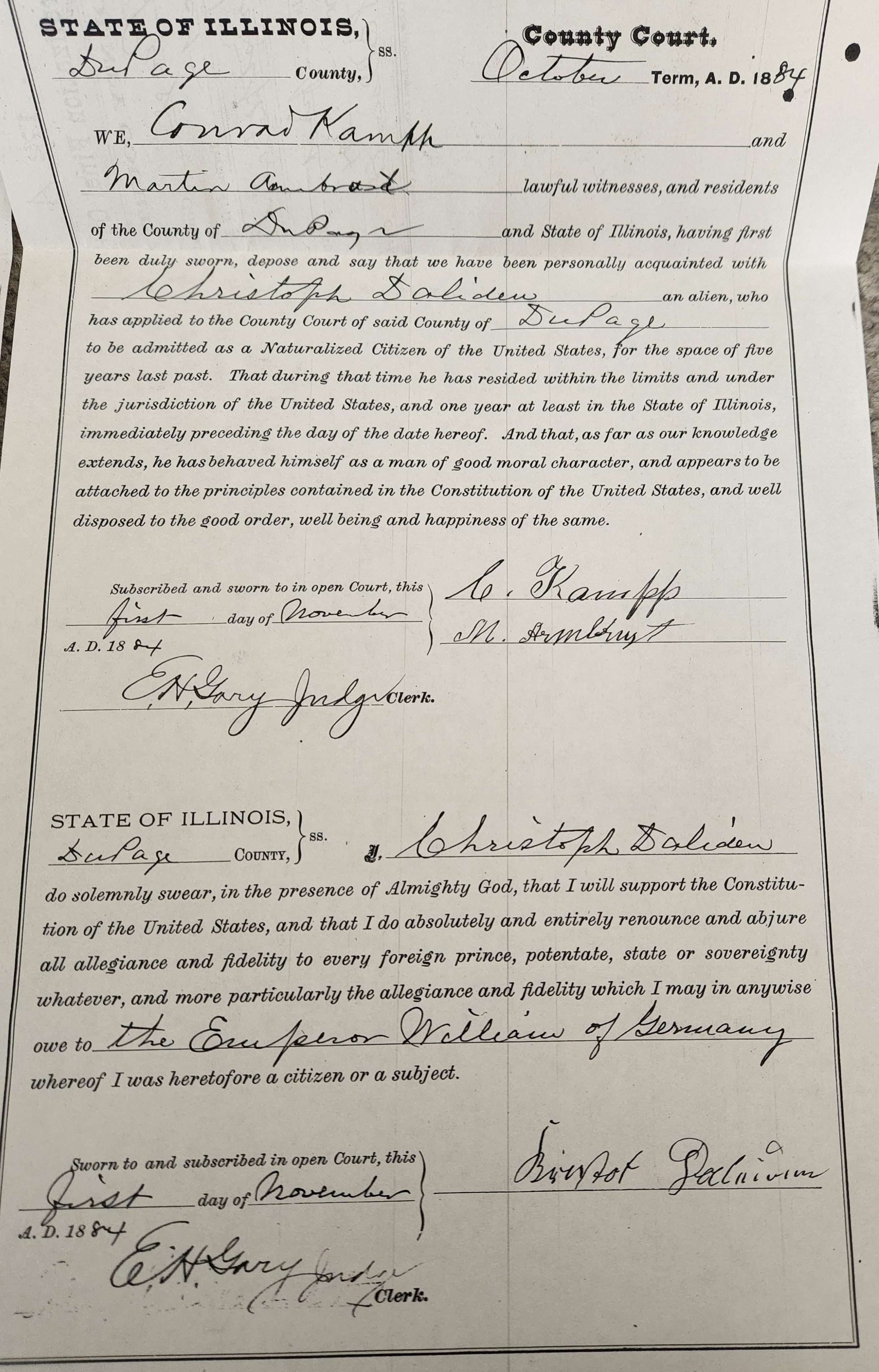
1 November 1884 is the final papers signed by Judge Elbert Gary for Christopher Daleiden’s Naturalization paperwork. Conrad Kampp and Martin Armbrust were signed witnesses and supporters of Christopher’s paperwork. Martin Armbrust’s daugher Mary Anne would later marry Joseph Schlick. Joseph in turn would have a son Casper Schlick who is this blogger’s Great Great Grandfather.
Posted in Christopher Daleiden, Daleidens, Genealogy Sources, Uncategorized | Leave a comment

Frank Schlick Remembers Growing Up on Mack Road in Winfield Township – Part 2

This is the second part of a two part blog posting of my interview with my Grandfather Frank Schlick in 1984 that was published in both the West Chicago (Illinois) Press and the Dupage County Genealogical Society (DCGS) Review. Click here for the first part of the blog posting.)

The home on Mack Road where Frank Schlick and his family lived from 1910 to 1970. Prior to 1910 the property was owned by Susan (Daleiden) Schlick father and uncle Christopher and Michael Daleiden beginning in 1866.
(Photo: Frank J. and Mae C. Schlick Estate Photo Archives.)

All of the food was cooked over a wood burning stove. Attached to the stove was a water retention pan so that warm water was always available for cleanup after work. When the need arose, a large tub was filled to bathe in.

Wood burning stove.

Light switches were unknown in the early 1900s. Electrical lines were not strung up in DuPage County until about 1929 so kerosene lamps were needed after dark. About the same time electricity came to the county, the horse and plow were replaced by the modern tractor and disk.

1890s ad of the New Juno Brand Central Draft Table Oil Lamp Sun Burner Hand

According to a 10 July 1903 Wheaton Illinoian news article:

ELECTRICITY ON THE FARM.

Electric machinery will probably supplant other motive power in the DuPage river valley. Already the steam and gasoline engines of the smaller villages are in the hands of junk dealers or accumulating the dust and cobwebs of idleness. Since the Traction company’s new power house in Batavia began business there has been an abundance or power for the road and . . . consumers along the line [The Chicago, Aurora, and Elgin Electric Interurban Line] It is now proposed to furnish light and power to farmhouses along the valley at a reasonable cost.

The picture of husky son of the soil pressing a button in his home to feed the horses, turning a switch to start the machinery to milk the cows and eating his breakfast by electrical light is no pipe drean. But may be a reality in the not far distant future.

The federal government’s New Deal Rural Electrification program changed the world and rural American during the Great Depression era. No longer would farmers have to milk cows in the dark. Getting “hooked up” as it was called by farmers allowed them to work longer hours with bright lights. For many milk cows it took time getting used to the lights, some it was reported did not provide milk for some time. Many farmers found that the lights were too bright.
(Photo credit: Kansas Historical Society website: https://www.kshs.org/kansapedia/rural-electrification/12189.)

Horsepower not gas power accomplished travel then. During the winter the team of horses was htiched to a sleigh and traversed the main north south route through the area, Winfield Road. It was often used by farmers transporting milk to the Chicago, Aurora, and Elgin Montview Electricline Railroad Station located just south of Butterfield Road (Illinois Route 56) near the intersection of Winfield Road. “Winfield Road,” Grandfather Schlick recalled, was a gravel road with a foot-high row of prairie grass growing between the two paths trampled by horses’ hoofs.

Horse drawn milk wagon.

In the spring, mud would be so deep it would come up to the horses’ knees. Spring floods often knocked out the Spring Brook Creek Bridge (located just north of the corner of Winfield and Mack Roads) and its logs would float away. The local farmers would gather them to put the bridge back together. “There was no such thing as county money (to make repairs) back then, ” Grandfather Schlick said.

Montview Train stop Chicago Aurora and Elgin.

At the age of 14 in 1925, he was hired on at St. James Farm at the corner of Butterfield and Winfield Roads. The farm was the estate of Chauncey McCormick a cousin of Colonel Robert R. McCormick. For two hours every morning he milked cows for the magnificent sum of .25 cents per an hour. “Boy, that was a lot of money back then,” he said. What began as a part-time job in his youth turned into a lifelong labor, retiring 60 years later.

St James Farm horse stable built in 1930s. (Photo: DuPage County Forest Preserve website: https://www.dupageforest.org/hubfs/Places-to-Go/Photos/St-James-Farm/red-brick-stable-st-james-farm.jpg.)

A model of thrift, he was able to save enough to put his horse aside and purchase a $300 Model A Ford.

In the days long before the Internet, chat rooms, cable and streaming, Instagram, FaceBook, video games or shopping malls, his free time was spent playing checkers or cards or dominoes, popping popcorn, for snacks and discussing the day’s work with his family. He fondly remembered his friends and neighboring farms rushing to his house to feast on homemake doughnuts.

The historic Chicago Theatre on State Street in Chicago..

Another happy memory was “free days” from school. “A bunch of us kids would fill half a coach of a Chicago and Northwestern train bound for Chicago. Once there we would catch a movie or visit the Shedd Aquarium after a meal at Berghoff’s Restaurant. It cost a whole $10.00 round-trip for five people! We were so tired from the trip we couldn’t move for two days after.”

Interior of a Chicago and Northwestern coach.
(Photo Credit: Paul Swanson, Midcontinent Railway Museum site: https://www.midcontinent.org/equipment-roster/cabooses/chicago-north-western-10802/)

“Yes, they were better days back then,” he said, with a hint of a smile toward the close of the interveiw. The less congested, complicated and forever gone days of turn-of-the century DuPage are memories now and most are fond remembrances.

The Casper and Susan Schlick family. This photo was taken at their home and farm in the 1920s. In this photo left to right are pictured: Albert, Susan (Daleiden), John, Casper and Francis or “Frank”.
(Photo: Frank J. and Mae C. Schlick Estate Photo Archive.)
Posted in Casper F. Schlick, Frank J. Schlick, Mack Road, Schlicks, St James Farm, Susan (Daleiden) Schlick, Uncategorized, Winfield History | Leave a comment