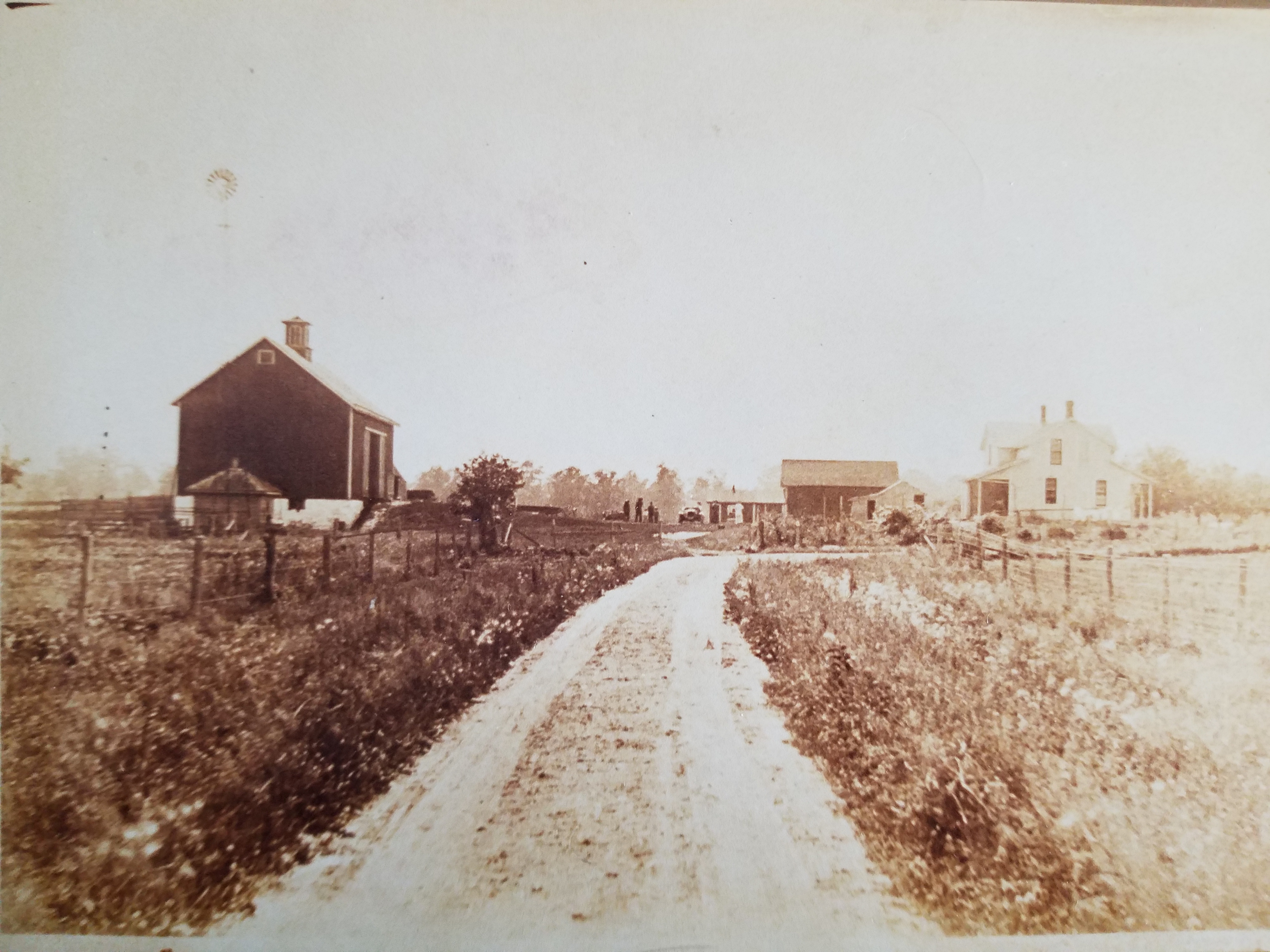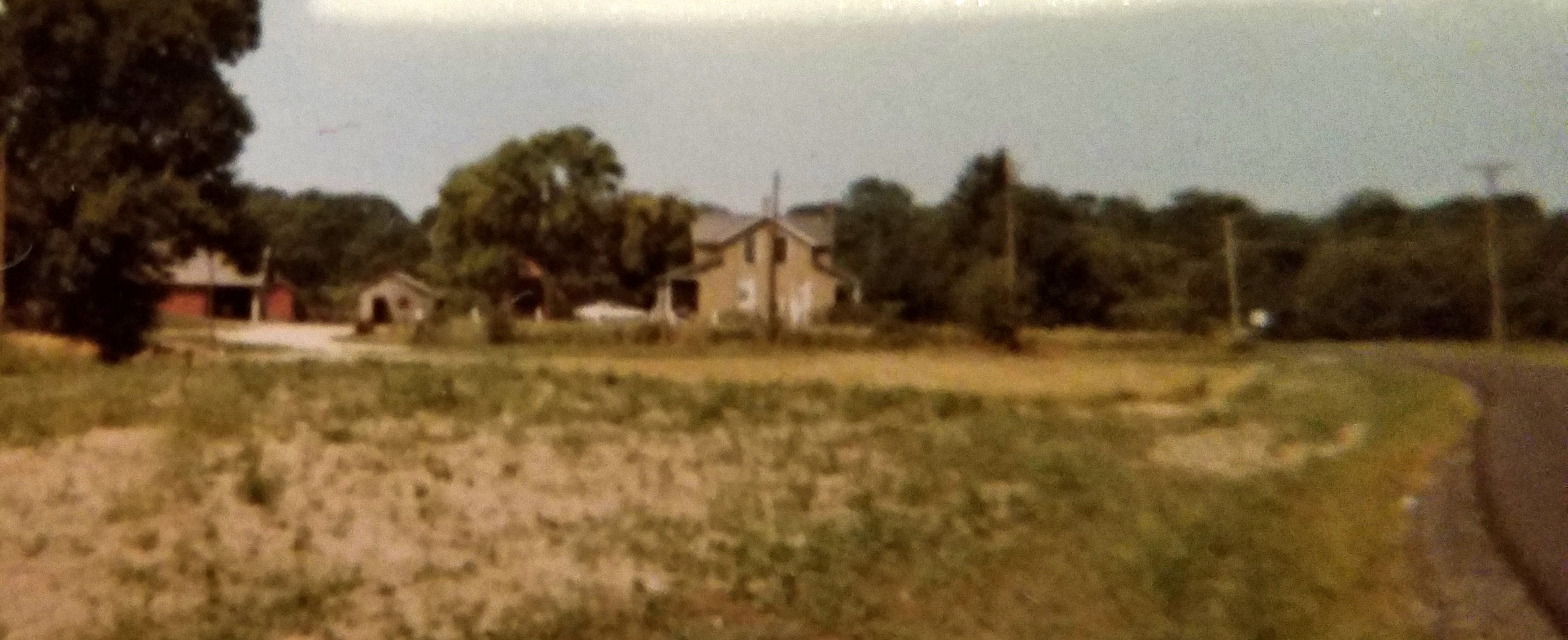
Daleiden and Schlick farm on Mack Road circa 1900s. (Photo: Frank J and Mae C. Schlick Estate).Daleiden and Schlick farm on Mack Road circa early 1970s just prior to demolition of the buildings. Note Mack Road is just on the right-hand side of this photo. The Mack Road “dogleg curve” had been straightened out. (Photo: Frank J and Mae C. Schlick Estate).
Property Tax Rolls are another source for genealogists to tap into for family history research. The Dupage County Tax Accessors Office, for example, has all Tax Roll records available on line at this link.
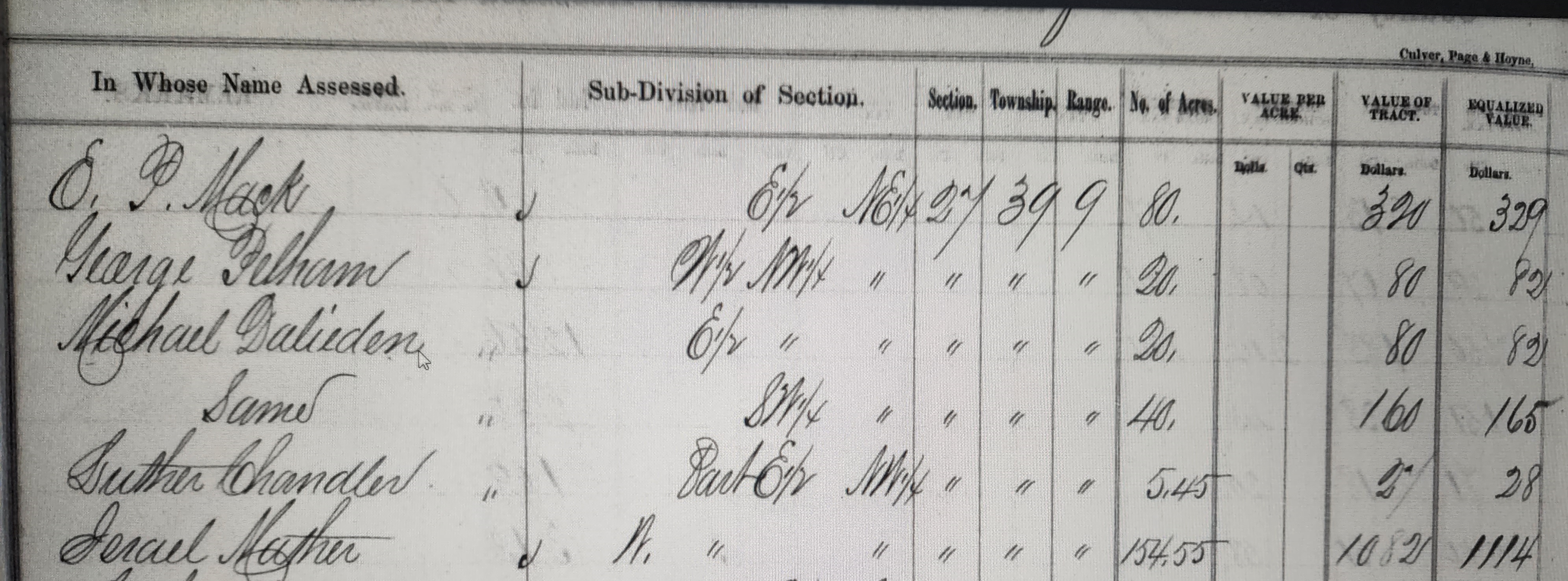
Michael Daleiden’s name is shown on the 1864 DuPage County Illinois Property Tax Rolls.His neighbors are “E.P. Mack and George Pelham”. This is the property on Mack Road in Winfield Township Illinois.
I turned to the Tax Roll records to gain a sense of when Michael Daleiden (Christopher Daleiden’s brother) owned land and was paying taxes in Winfield Township in Dupage County Illinois. The 1864 listing provided a legal description verifying the Township, Range, Section, half and quarter Section of where the property was located. I will use this information to tract down any land deeds showing when Michael actually purchased the property on Mack Road. I used the 1874 Atlas for Dupage County and worked back in the Tax Roll records year-by-year until I located Michael’s name for the first time on the Tax Rolls 1864. Could this be narrowing down the clues as to the whereabouts of Michael following his immigration to American? His name was not on any of the Rolls prior to the year of 1864.
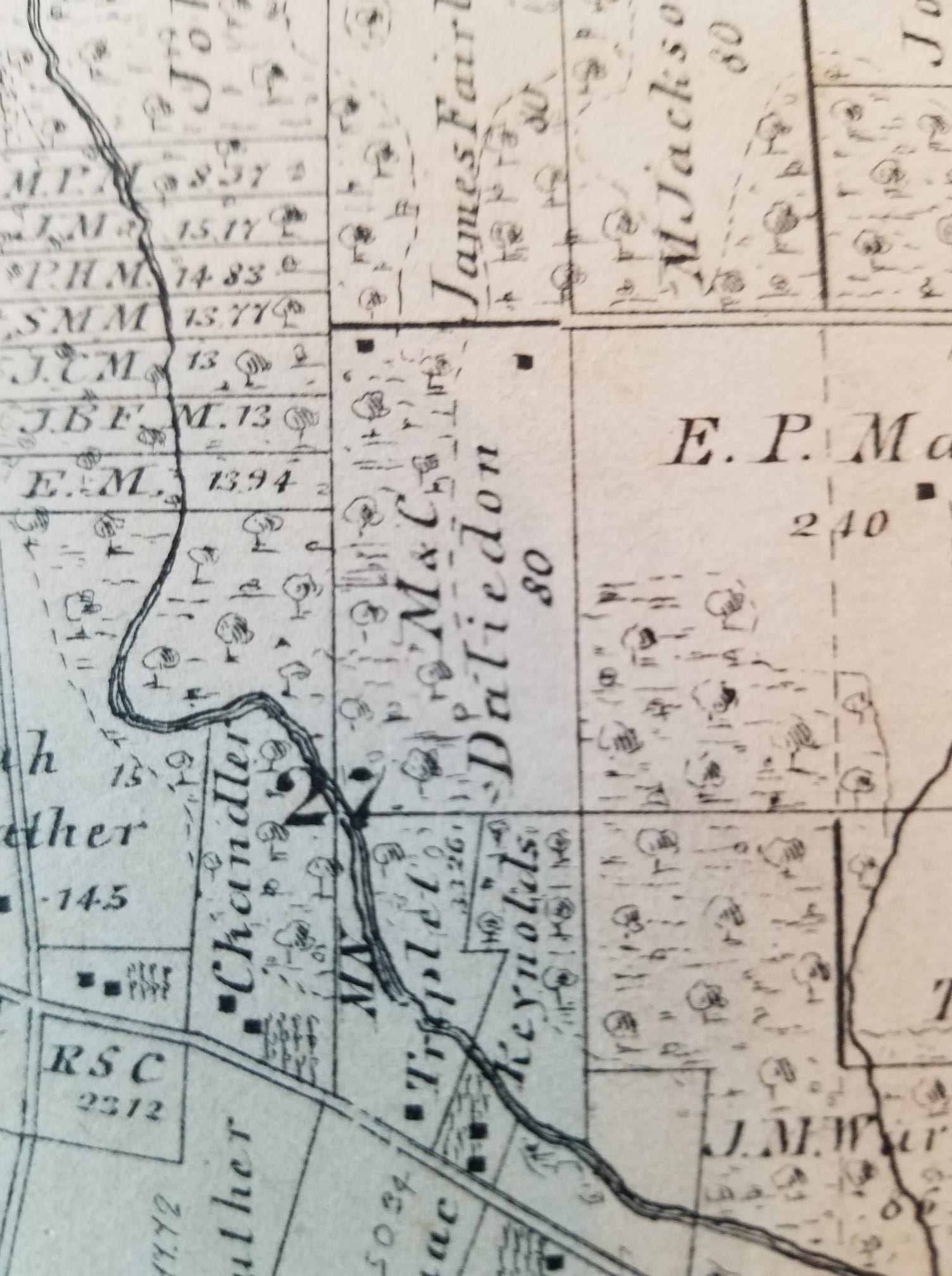
This 1874 DuPage Atlas records Michael and Christopher owned eighty acres of property on Mack Road in Winfield Township near the West Branch of the DuPage River. Source: Illinois Digital Archives link: http://www.idaillinois.org/digital/collection/npl/id/11053
The other benefit of reviewing the Tax Rolls side-by-side with the U.S. Census is learning surnames of what has been termed by Genealogists as F.A.N.s (Friends, Associates and Neighbors). The large and longtime landowners along Mack Road include: Macks, Fairbanks, Mathers, Triplets and Chandlers. Using the DuPage County mug book or a local history book you can see if their names are listed with biographies of their lives.
I discovered that many of the properties on the map did not contain any buildings or other structures. I am learning that many families and farmers owned wooded lots or empty fields for the practical matter of not only for investment in the land but also as a source of wood for keeping their homes warm in the winter and fields for the planting of hay and other crops. The Daleidens and the Schlicks used wood burning stoves for many decades to heat their homes and cook their meals. The Mather Family members owned seven lots per this map. Casper Schlick in furture years purchased some of the Mather Estate lots and properties just to the west of his property.
The Armbrust family of Bloomingdale and Wheaton in DuPage County Illinois have contributed a great deal to the development and business life of the City of Wheaton Illinois. The family is intermarried with the Schlick family many times!
The DuPage County Farm Bureau Plat Atlas for 1947. Shown above is the area in Milton Township upper northwest corner from Wheaton Illinois. This shows the Pleasant Hill Subdivision [P.L HILL on map] off of Pleasant Hill and Jewel Roads in Wheaton. J. Armbrust owned about 83.02 acres of property north of the Pleasant Hill Subdivision.
Mary Anne (nee Armbrust) Schlick would marry and raise a family in Burlington Illinois with Joseph Schlick. Martin Armbrust was the father of Mary Anne Schlick. John Armbrust, Martin’s son, would marry Katherine Daleiden. Katherine Daleiden was the youngest daughter of Christopher Daleiden. Christopher was one of the early 1860s immigrants from Germany to settle in Winfield Township in DuPage County Illinois.
This photo taken on October 1906 on the front porch of the Christopher Daleiden home on Church St. in Winfield shows members of the Armbrust Family and Schlick Family together. Martin Schlick (he is the man with the white beard) is standing with Christopher and Margaret Daleiden to his right. This event was the wedding of Susan and Casper Schlick. (Photo Credit: Frank J. and Mae C. Schlick Estate Photo Archive).
The Armbrusts owned a large tract of land and a farm at the corner of Geneva and Pleasant Hill Roads in Milton Township just northwest of the town of Wheaton Illinois. The family developed just south of their farm a small settlement called Pleasant Hill. The main focal point of this settlement was the Chicago, Aurora, and Elgin had a depot or stop just south of Jewell Road that was in the settlement. The only remnants are the small store and several of the homes that were built in the area.
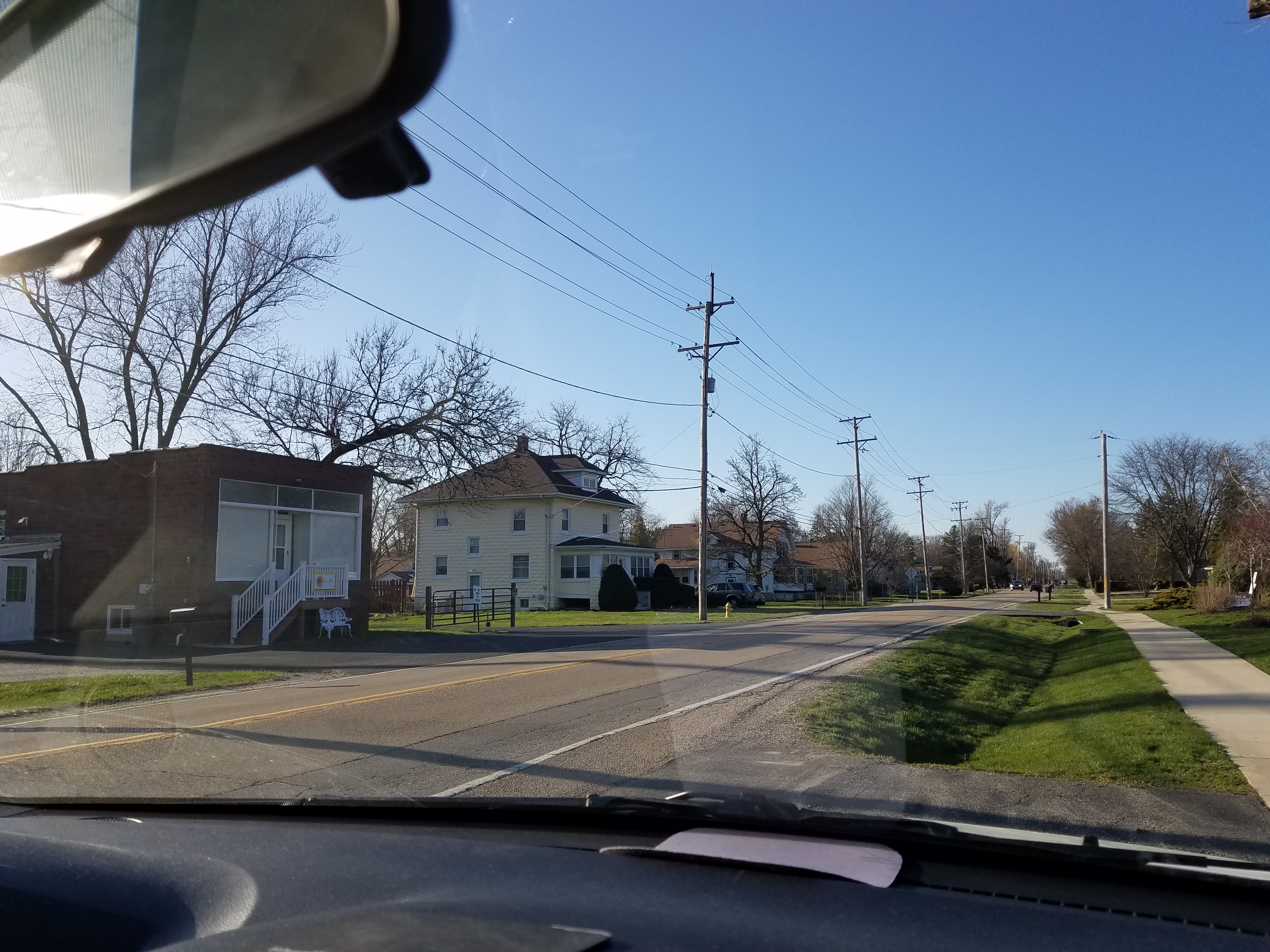
This photo was taken from my parked car on Pleasant Hill Road just north of Jewell Road and south of Geneva Road in the northwestern part of Wheaton, Illinois in Milton Township in DuPage County Illinois. The former Pleasant Hill store (now a private residence) is located just north of the Chicago, Aurora, and Elgin Electric Interurban Line stop.
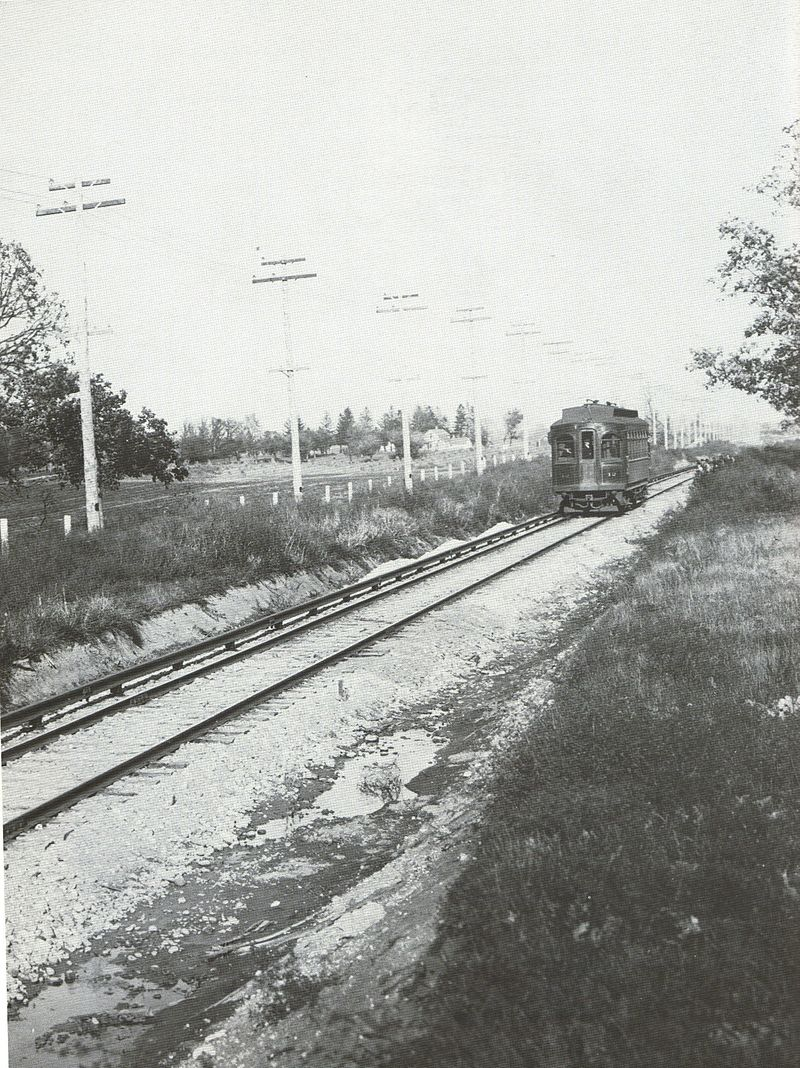
A 1902 photo of a CA&E train southwest of Wheaton. Note the “third rail” running alongside the two tracks. The third rail provided electrical power to power and make the train run on the track. (Source: Wikipedia: https://en.wikipedia.org/wiki/Chicago_Aurora_and_Elgin_Railroad)
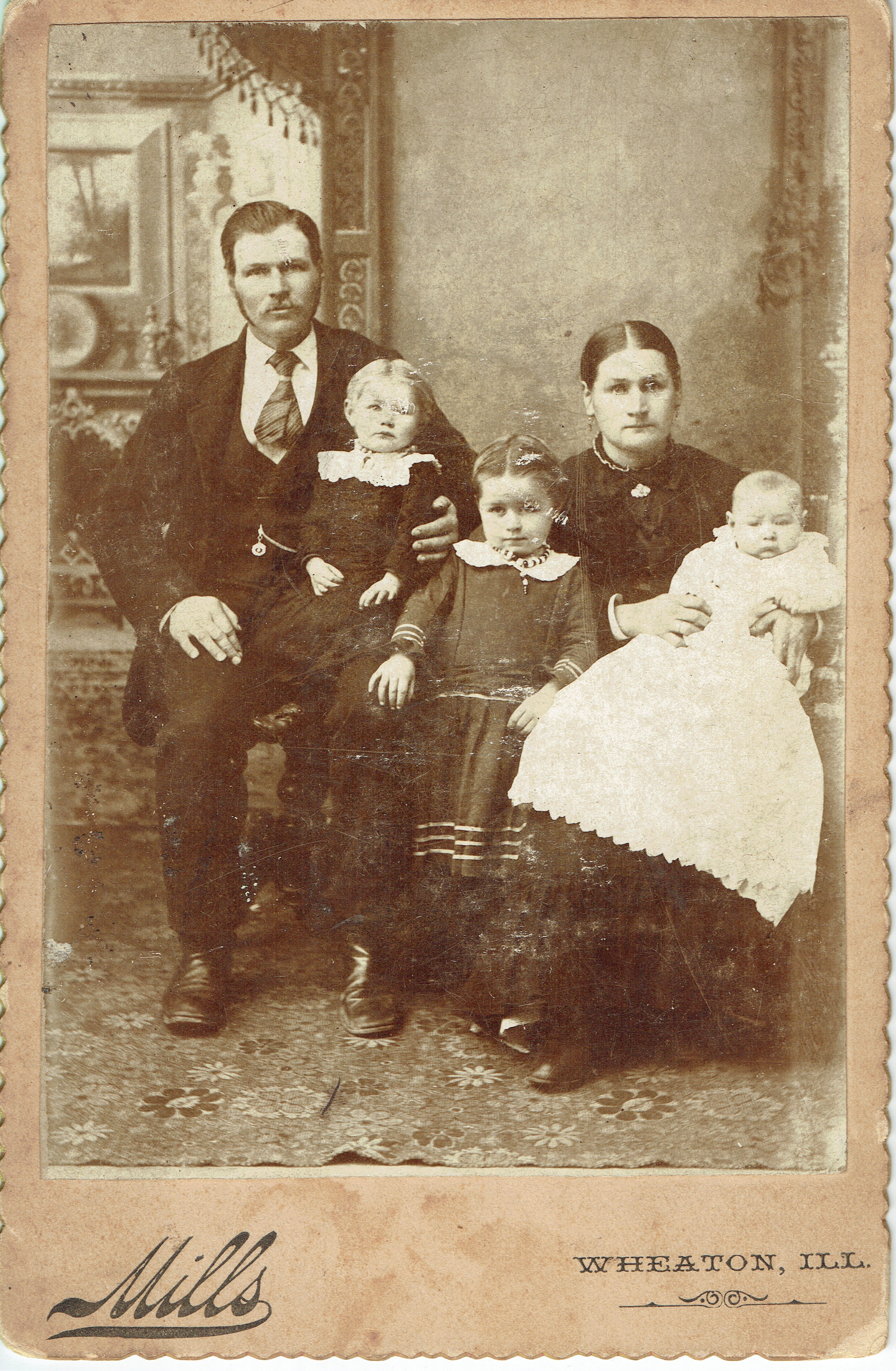
Joseph Armbrust and his wife Mary, and three of their children (not identified). Photo dates to c. 1895-98. Joseph planned and layed out the Pleasant Hill settlement/subdivision south of his farm property. ( Source: Find A Grave Website Accessed 3/7/2022.).
Joseph Armbrust the son of Martin Armbrust planned Pleasant Hill. “Joseph Armbrust was educated in the district schools of Bloomingdale Township Illinois and the parochials school at Winfield [St Johns Catholic School on Church Street], and remained with his father until 1877, when he married and rented one of the latter’s farms for six years. In 1883 he purchased ninety acres of land in Section 6 and 7 of Milton Township [located near the present corner of Geneva and Pleasant Hill Roads north of Wheaton Illinois and south of Carol Stream Illinois], later added thirty acres, and operated this farm successfully until 1903, when he retired. He has reserved ten acres of land for his own use, and has here erected a modern residence with all possible conveniences. In 1909 he laid out part of his land on the southern portion of his farm into lots calling this subdivision Pleasant Hill. He has the streets graded, shad trees planted, a drainage system installed and is preparing the instllation of an excellent water system. His farm is most pleasantly situated near Wheaton on the Aurora & Elgin line [later renamed the Chicago, Aurora, and Elgin Electric interurban rail line] (Source: Historical Encyclopedia of Illinois and History of Du Page County: Historical and Biographical .Munsell Pub. Co., 1913 )
The Martin Armbrust family of DuPage County Illinois. Standing in the back row: Joseph (Joe), Anthony, Louis and Frank Armbrust. Front row seated: Mary Anna (Armbrust) Schlick*, Martin Armbrust, Sr., Anna Mary (Munsinger) Armbrust and Mrs. Martin (Caroline Armbrust) Sittler. (*= Note: Mary Anna married Joseph Schlick of Glen Ellyn and moved to Burlington to raise her family.). (Photo credit: James Weberpal Estate Photo Collection.),
In the course of my research many questions keep coming into my mind. One article I read online this past month is titled “German Naming Traditions Genealogists Should Know by Diane Haddad on the Family Tree Magazine website.
The one item that has been frustrating in researching my Schlick and Daleiden family members is the fact that several of my relatives had the same first names within the same immediate family. When the mom (Margaret Daleiden) would call for “William” I image would get three people responding to her call: her husband, her son and potentially her first born male grandson. What is the deal and what is going on here I thought?
Haddad’s article laid out in plain language how this naming convention took place.The first born son of a family would be named after their father’s father. Example: Joseph Schlick’s first born son was named Casper Schlick. Casper was named after his grandfather Casper Schlick. The second born son was named after the mother’s father. Example Joseph Schlick’s second born son was named Joseph L. Schlick after his wife Mary Anne (nee Armbrust) Schlick’s father Martin Armbrust.
I have also run across two women born within the same family with the same first names. Example: Matthias Daleiden had two daughters listed on the passenger list named “Barbara”. This can be complicated if one does not keep a score card on a three by five index card. It also helps me explaining names and relationships at family reunions. Many of my relatives had issues keeping the two Caspers separated in their minds when discussing the Schlick family. I had to specify that the Casper that “came over on the boat” was different from the Casper Schlick that lived on Mack Road on a farm.
Many Roman Catholics used the names of Saints (Peter, Daniel, etc.). Casper Schlick is named after one of the three wise men who visited Jesus at the nativity. Saint Caspar (otherwise known as Casper, Gaspar, Kaspar, and other variations) was one of the ‘Three Kings’, along with Melchior and Balthazar, representing the wise men or ‘Biblical Magi’ mentioned in the Bible in the Gospel of Matthew, verses 2:1-9.
To recap I will excerpt a portion of Haddad’s article:
“In German speaking areas, children were almost always named for one or more of their baptismal sponsors. The most common pattern would be for sons to be named in this order:
This past week I was at the Wheaton (Illinois) Public Library poking into their genealogy print collection. At one time the Wheaton Library was known as having one of the best genealogical collections of any public library in the Chicagoland area. They have a locked bookcase on the second floor in the collection with many local DuPage County history books.
One book I pulled off the shelves was Dictionary of German Names by Hans Bahlow, Henry Geitz, Translator and Editor. (Max Kade Institute for German-American Studies University of Wisconsin-Madison, 1993). Here is the entry for the Schlick Family name and definitions.
Schlick(freg. in Hbg), also Schlicks, Schlickmann: LGer. schlick = ‘mud’, cf. pl.us. Schlickum, Schlicken, Schlickeilde, Schlickau, loc.n. Schlickriede . Schlickenrieder is UGer. (ried ‘swampy area’). But MHG slic (Schlick) means a person who is intemperate in eating or drinking, from slicken ‘ to gorge, guzzle, or swallow’ (“ir sit ein slit under slunthart”); cf. the sentence names Schlickenbrei, Schlicksupp, Schlicksbier, Schlickespise (Bruchsai 1295). Schlickenpraten (Budweis 1386), HeinrichSchlick (Eger 1394), progenitor of the noble family Schlick (count).
The Daleidens arrived from the port of Antwerp in Belgium in the late 1850s to New York. According to Genealogist Steve Szabados in his book German Immigation to America: The Who, Why, How and Where ( 2020), “. . . Antwerp was an essential trading center in the low countries before it became a major departure port for emigrants“. The city’s “connection to the Rhine River traffic and it’s link to ships traveling to America was an essential factor to attract immigrants“.
There was several developments enabling the surge of immigration to America. Two primary developments were the lowering of costs of travel and the increase of railroad transportation connections to ports. Steerage fares were introduced around 1850. The cost for Steerage was around $16 per person. $16 in 1850 is equivalent in purchasing power to about $581.98 today (2022). For the Daleidens this would have cost $3,491.88 in 2022 ( $96 in 1850s).
Steerage was the “part of a sailing ship below the quarterdeck. Sailors called it the steerage area because the steering tackle ran through this area to connect the helm to the rudder of the ship”. The building of railroads in Europe were used as a convenance by immigrants to Antwerp and other ports of departure. Trade agreements also kept goods moving to America via the immigrant ports and this increased the number of ships traveling available to immigrants traveling back and forth between America and Europe.
The first wave of my Schlick family (Casper and Margaret) arrived from the port of Bremen in Germany in 1852 to New York. Breman was a port of departure for immigrants starting in 1825 and by 1830 according to Szabados, “The port began serving as the embarkation point for the majority of immigrants from central and eastern Europe bound for America“. The port authorities of Bremen, “tried to improve the quality of life for immigrants, and their rules earned a reputation as the best port from which to emigrate“. Ship owners had to supply “Bremen authority’s with passenger lists for each voyage, and the harbor officials required that the shipowners had to absorb the expense for each emigrant who the United States immigration officials rejected“. This information exhibits the fact that the Schlicks left from a well tended Port. Szabados’ book (page 44) offers a great description of travel on a ship in the 1850s. This description provides a sense and some context on what it may have been like to travel thousand of miles to a new home and country:
Steerage passage on sailing ships in the 1850s meant our German ancestors found themselves in converted cargo holds with hammocks strung up to provide places to sleep. These quarters were small and crowded, and many times the passengers shared the hammocks with one or two other immigrants with each taking their turns sleeping. They endured unsanitary conditions, cramped quarters, disgusting odors, and little privacy. Toilet facilities in steerage consisted of a few buckets with private screens. The steerage passengers used cooking stations that were set up on deck to prepare their food that they had brought. Shipping companies did not provide food to the early steerage passengers on the voyage. Illnesses developed quickly among the young and elderly, and diseases spread quickly. Many passengers arrived in their new land sick, and many died at sea.
I encourage you to purchase or locate this book in your local public library for more in depth information on the German Immigrant experience.
In part two of this two part blog together we will look at what life was like coming into America at the port of New York.
St James Farm was central to the family history of Frank and Mae Schlick and then the George and Louise Davis family. I went every Sunday to St James Farm to visit my Grandpa and Grandma Schlick. I rode bikes on the Farm and visited the horses in the Red Brick Stable. Here is a clip on its history that I contributed a short segment.
I try to keep up with new materials being published (in print and online) covering local history for both Dupage and Kane County. The Dupage County Forest Preserve District has a blog that it adds information to on a regular basis. One of posting subjects is the history behind some of the preserves in Dupage County. There blog postings are located at this link.
Recent blog posting have included:
Hidden History of the Blackwell Mammoth. Blackwell Preserve is part of the former Mack and Schlick family farmsteads. As a matter of fact the Mammoth remains were found in a former field owned by Casper Schlick.
Hidden History of the Chicago, Aurora & Elgin Railroad. This blog is of interest due to the fact that the CA and E Railroad was a regular convenance that the Schlicks and my parents took advantage of on a regular basis. My parrents used it for their date days and nights to go to the City of Aurora to see a movie and to go shopping. Casper Schlick used the CA and E as means to ship his excess milk into the City of Chicago for processing at one of the many Dairy plants in the city.
The Hidden History of Winfield Mounds. This blog posting uncovers the history of the burial mounds of local Native Americans that lived along the West Branch of the DuPage River.
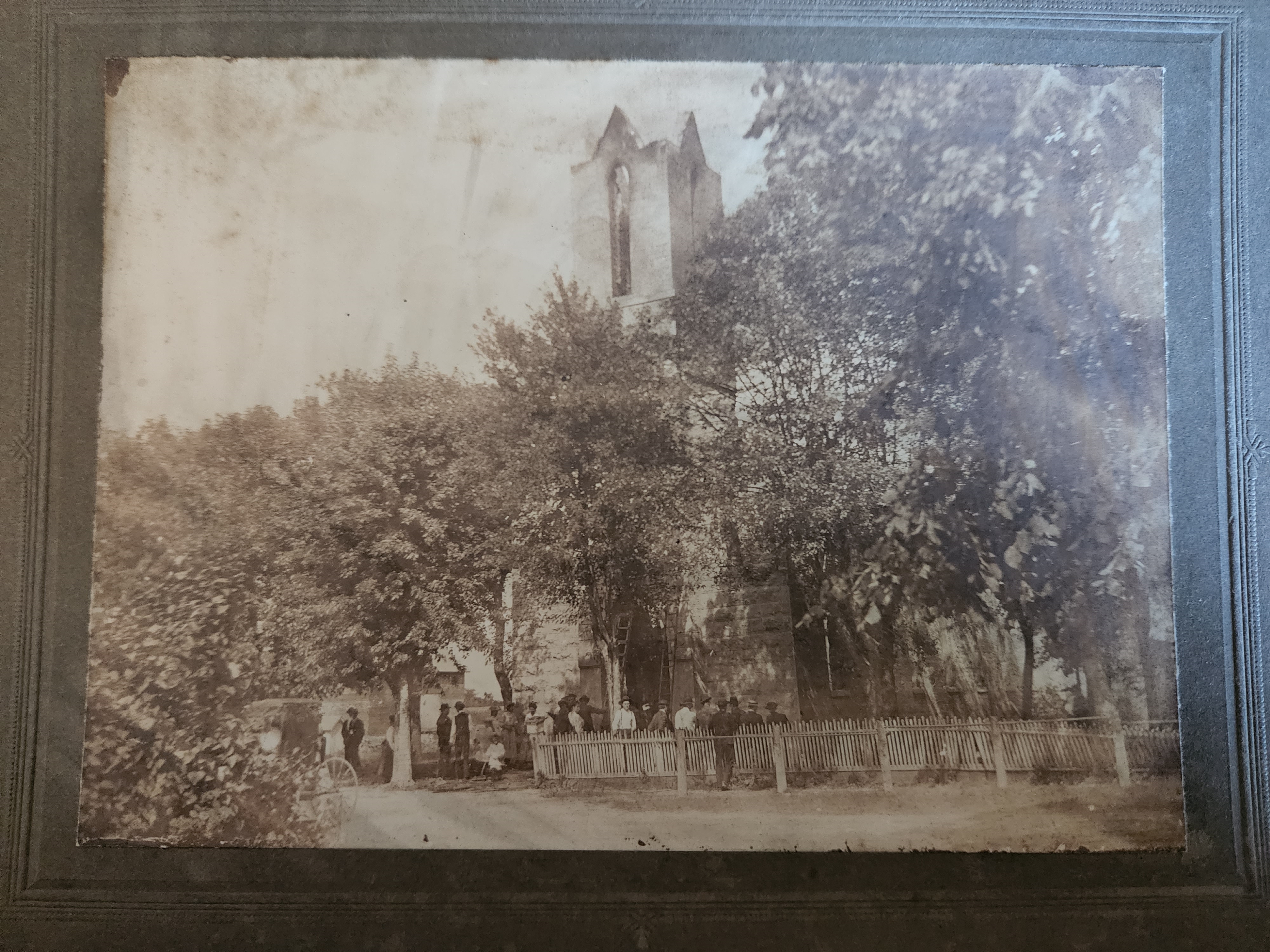
St John the Baptist Catholic Church August 1906 day after the fire Saturday August 5, 1906.[Photo courtesy of the Frank J. and Mae C. Schlick Family Estate Archive.]
Casper and Susan Schlick were married in 1906, however this was the same year that St. John church was burned due to a summer storm. Here is how the Wheaton Illinoian reported the fire on the front page of the Friday, August 4 1906 issue.
Catholic Church at Winfield Destroyed
Lightning Friday afternoon [Friday August 17, 1906] struck the Catholic church in Winfield completely destroying a $ 12,000 structure.
The fire occurred during the severe electrical storm which passed over Wheaton and vicinity Friday afternoon about 3 o’clock. It was only a half hour from the time the first bolt struck the large structure, until it was a smoldering mass of ruin.
The church building was constructed of solid stone, but the tower was built of wood and against this the bolt of lightning struck, throwing tongues of flames in every direction and completely enveloping the entire structure.
When it was seen that the fire would soon be beyond the control of the men grew means to fight fire in the village, the wheaton and West Chicago hook and ladder companies were called and their work is due the saving of the buildings about the church and perhaps the whole town.
Rev. Father Wiederhold is pastor of the church. He states that the total loss after insurance is deducted will approximate $ 6,000.
The gold and silver fixtures in the church were also all destroyed. In all probability the church will be rebuilt at once.
The fire may have destroyed the building that the German immigrants worshiped in but it did not crush their spirits. They were tough and resolute people. Within less than one year a new church was built over the foundation of the old Church.
The Wheaton Illinoan reported on Friday, August 23, 1907: The new St. John church in Winfield was dedicated Sunday [August 18, 1907] with appropriate ceremonies. Archbishop Quigley of Chicago had charge of the services assisted by priests from neighboring parishes. Many people from Wheaton were in attendance.
If one goes to the east side of the church today and peers into the basement window at the ground level you can still see the old foundation in the basement.
Remember that the church is not a building. The “church” is the people who are a members of a similar faith coming together to worship their God.
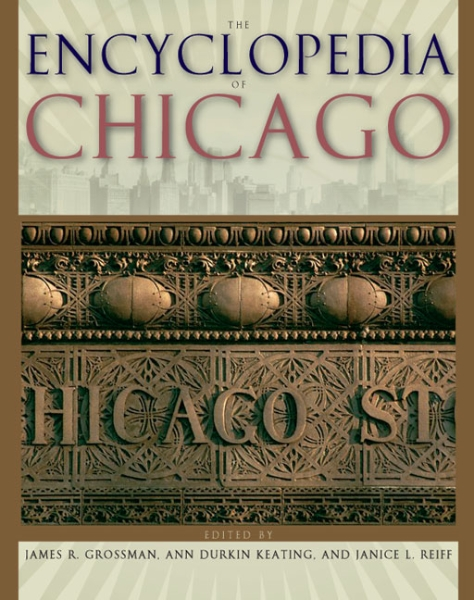
James R. Grossman, Ann Durkin Keating, and Janice Rieff, Editors. Encyclopedia of Chicago, U. of Chicago Press. 2004.
The surrounding suburbs of Chicago are dependent on the city of Chicago for its economic wellbeing. They are interconnected. We as family historians need to read information on the large cities located near our family farms and suburban residences. Here are the sources I recommend for your research.
The Encyclopedia of Chicago is an excellent resource for anyone interested in the history of Chicago and the surrounding Chicagoland suburbs. This book has a companion website sponsored by the Chicago History Museum and the Newberry Library. There are entries in the book for Winfield, Burlington, Hampshire, Kane and DuPage Counties. This book is a great resource for family historians and genealogists. If you had relatives living in Chicago you can search for entries on the history of many Chicago neighborhoods. One example, I was in need of a concise overview of the Englewood neighborhood near 63rd and Halsted. This is the area where my father George Davis grew up, went to school in and worked.
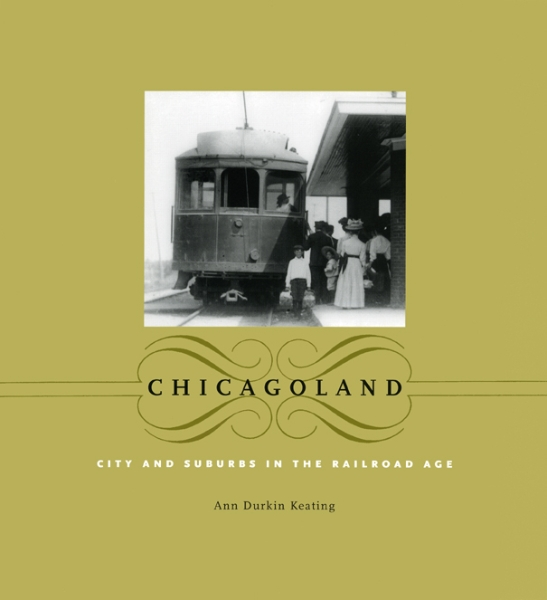
Ann Durkin Keating. Chicagoland: City and Suburbs in the Railroad Age. University of Chicago Press. 2005.
Ann Keating is a well respected Historian. She is the Dr. C. Frederick Toenniges Professor of History at North Central College in Naperville Illinois. I consider her one of my mentors and some that had encouraged my interest in Chicagoland history. This is one of my favorite books on local history for Chicagoland. It provides an excellent overview of the many “types of suburban” communities that ring the Chicago area. This book provides the context for understanding the growth of Chicagoland and drives home how interdependent the suburbs and Chicago were in the past and continue to be for the future for their economic well being.
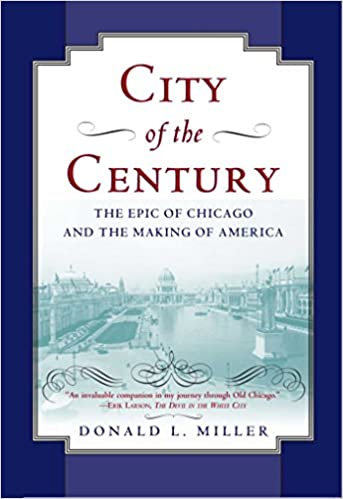
Donald L. Miller. City of the Century: The Epic of Chicago and the Making of America. Simon and Schuster. 1996.
Donald Miller’s book provides an in-depth history of the growth of Chicago from its discovery and founding through to the 1893 World’s Columbian Exposition. In order to understand the growth of DuPage and Kane Counties in Illinois one needs to understand the history and development of Chicago as a City. If one is fortunate to be related to a person that settled in Chicago there are many small biographies and overviews scattered throughout the book. This is well written for a general reading audience.
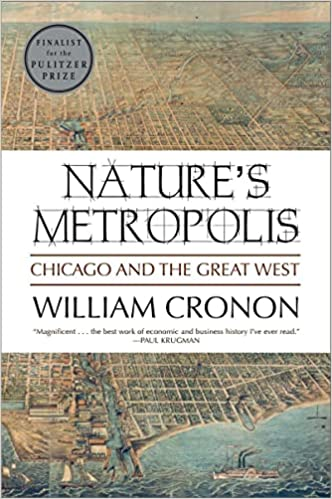
William Cronon. Nature’s Metropolis; Chicago and the Great West. W. W. Norton Publishers. Revised Edition 1992.
William Cronon is an environmental historian and the Frederick Jackson Turner and Vilas Research Professor of History, Geography, and Environmental Studies at the University of Wisconsin at Madison.
In this book Cronon; “. . . gives us an environmental perspective on the history of nineteenth-century America. By exploring the ecological and economic changes that made Chicago America’s most dynamic city and the Great West its hinterland, Mr. Cronon opens a new window onto our national past. This is the story of city and country becoming ever more tightly bound in a system so powerful that it reshaped the American landscape and transformed American culture. The world that emerged is our own.” (Source: Amazononline book description accessed 3/2/2022). This work drives home the point that Chicago and its suburbs were dependent upon each other for their growth and economic well being.
The Village of Winfield was incorporated as a Village on April 16, 1921. In 2021 the Village celebrated its centennial year of incorporation. “While some still wanted their rural life undisturbed, many felt that improvements now were due. Better commuter schedules was one hope, upgraded telephone service another, but it was the demand for street lights which gave particular impetus to the drive [ toward incorporation]” ( Louise Spanke Winfield Good Old Days: A History (1978) pp 61).
I grew up in Winfield from the beginning of the nineteen sixties through the end of the nineteen eighties. I have witnessed so many changes. I have seen the disappearance of so many familiar buildings that I remember as a child. I can still remember walking each morning to Winfield Elementary School from my home on the east end of Beecher. To me as a young child the school seemed so far away from my home. I remember that there was no stop lights, nor curbing or any sidewalks. Beecher Street, at least the end I lived on, was not paved. The street dust and dirt was kept to a minimum by the Village with an application of a layer of tar topped off with a layer of small stone pebbles. I can still hear the tar and gravel making noise on my dad’s car wheels as we drove down the street. The roadway surface would eventually harden to form a firm surface to drive and walk upon. The roadways were narrower back then.
The train depot in Winfield Illinois.
Louise Spanke in Winfield Good Old Days: A History (1978) provides a brief window into the community of 1921. In 1921 Winfield’s population was only 310 people. Many of the businesses and trades included: “grocery, general merchandise store, confectionary, ice cream or refreshment parlor, meat market, garage, coal business, ice business, photography gallery, junk dealer, auctioneer, electrician, plumber, milk dealer“.
One interesting fact is that with the incorporation of the town there came changes to the street names. Spanke in her book reports the following street name changes: “Only Franklin Street [later to become Highlake] kept its original name under the new regime. John Street was changed to Church, Paul became Park and Frederick Street and Beecher Road were combined to make Beecher Avenue. Warren Road become East Street; Marion, extended east, was designated Washington. Elizabeth Street became a part of Jewell Road, renamed Winfield Avenue, and Gary’s Mill and Manchester Road were combined as Lincoln Avenue. The historic names of Jewell, Gary’s Mill and Manchester Road were restored in 1955“.
The end papers of Spanke’s book contains a two page spread showing “Winfield, Illinois, c. 1905“. The “Map drawn from memory by Lawrence Enders in consultation with George Roger Higgins, Anthony and Cornelia (Higgins) Besch, Alice (Higgins) Neubauer, Jacob and Mary (Schmidt) Zeier, Lena (Schmidt) Higgins, Michael and Laura (Schmitt) Tinnes.”
This is the end papers showing the map of Winfield. It is valuable for genealogists as it contains many of the residents home at the time. At number 39 is the resident of Michael Daleiden. This home was once located just north of St. John’s Church. Number 39 was the former home of Christopher and Margaret Daleiden. Number 50 is the Winfield Cooperative Creamery. Number 32 is the home of William B. Daleiden. This is at the corner of Frederick Street (now Beecher Ave) and Main Street (now Winfield Road). Number 22 is the Jacob Baum Store near the Railroad Depot and train tracks. The Baum Store would later become the Bluebird Confactionary Store owned by William B. Daleiden. Note that there is no Winfield Road. The main street through the town at the time was John Street (now Church Street). There were two road crossings over the railroad tracks one at John St. and another at Main St. (Now Winfield Rd). Main St. stops at Frederick Street. Today Winfield Road is now the only crossing over the railroad. A new depot is just off of Jewell Road and west of Winfield Road. The above list is a key to the above map circa 1905.
I remember Mr. Lawrence Enders or Larry as my parents called him. He lived in the second home on the on the north side of Beecher Street east of Church Street. I believe that another generation of the Enders family still lives in this house. My grandfather Frank Schlick told me that Larry’s house was once the barn for Nicholas Ender’s homestead and property. The Nicholas Enders home is now a business called Antiques and Chic (0S125 Church Street). At one time there was also an old stone smoke house on the property. This old structure was used to smoke and to cure meat. The smoke house was disassembled, moved, relocated and reassembled on the grounds of the Stacy’s Tavern Historic Museum (561 Elm St, in Glen Ellyn Illinois). When you have a chance stop and check out this interesting structure.
Stacy’s Tavern at the historic “five corners” on the north side of Glen Ellyn, Illinois. This is where Nicholas Ender’s smoke house was relocated and can be viewed today on the property. (Photo credit Stacy’s Tavern Facebook page).
The Winfield Historical Society’s Hedges Station Museum is now the owner and caretake of this diorama of the Village of Winfield based upon his 1905 map he drew for Spanke’s book on Winfield History. The very large layout on plywood was once housed at the Winfield Fuel and Materials Company’s office and store. It was moved to the Museum prior to the demolition of the Fuel Co. main building.