Jerry Apps Farm Historian and Storyteller

I have through their writings become acquainted with many historians and writers. In a previous blog I wrote about David McCullough. Another writer and historian that I admire is Jerry Apps. Apps lives in Wisconsin and is a prolific author and has produced several PBS documentaries on farming and growing up on a farm in Wisconsin. Here is a link to the Wisconsin State Historical Society online book shop that sells many of his books and PBS public television documentaries. The books and DVDs are also available via your local public library or your local library’s interlibrary loan services.

The information that I learned from Mr. Apps was the fact that living and working on a family farm was tough, dirty, dusty,and neverending. It also solidified by believe in the value of family and in the importance of helping your neighbor.

Posted in Genealogy Sources, Uncategorized | 1 Comment

Illinois and Midwest Agricultural History Books

Throughout the past several years I have run across several books that cover Illinois, Midwest or agricultual history. When you are working on family history research you need to read books to find contextual information on the places where you ancestors lived and the work that your ancestors performed when they were alive.

Several of my ancestor on the maternal side of my family were farmers. One book that I purchased was Carrie Meyer’s Days on the Family Farm: From the Golden Age through the Great Depression (University of Minnesota Press. 2007)

Here is a brief description of Meyer’s book from the publisher:

From the beginning of the twentieth century to World War II, farm wife May Lyford Davis kept a daily chronicle that today offers a window into a way of life that has all but disappeared. May and her husband Elmo lived through two decades of prosperity, the Great Depression, and two World Wars in their Midwestern farming community. May and Elmo’s story, engagingly told by Carrie A. Meyer, showcases the large-scale evolution of agriculture from horses to automobile and tractors, a surprisingly vibrant family and community life, and the business of commercial farming. Details such as what items were bought and sold, what was planted and harvested, the temperature and rainfall, births and deaths, and the direction of the wind are gathered to reveal a rich picture of a world shared by many small farmers.

While May and Elmo Davis were not my relatives the fact that they lived on a farm near Rockford Illinois in northern Illinois attracted my attention and interest enough to purchase the book. The Schlicks and the Daleidens were farming families and also lived in Illinois. The time I spent reading this book provided some “flesh and bones” to what it was like to live and work as farmers from the turn of the twentieth century through the Great Depression of the nineteen thirties.

An added bonus within the text of the books was the fact that Meyer included some local and national events that occurred during Elmo and May Davis’ lifetime. My point in listing this book is our ancestors did not live in bubbles. National events ( e.g. the Great Depression and World War II) did impact their lives and at a local level.

American Agriculture : Brief History

R. Douglas Hunt. American Agriculture: A Brief History ( John Wiley & Sons. 1994). Douglas’ book I happened to stumble upon and purchase while attending the Public Library Association Conference when it was held in Indianapolis Indiana. I simply love this book due to the fact that it provides a capsule history of farming and agriculature in the United States.

When I first look at a book I read the dust jacket blurb, then the introduction and acknowlegement pages. I then review the bibliography of works consulted and the footnotes of the book. I gain insight into the authors use of other sources that I might be able to tap into for my research. I then probe and skim through the index to look at the subjects it covers such as the headings: Illinois, Midwest, and Chicago.

Douglas throughout the book provides an overview of what was happening in different regions of the country involving farms and farming. My point in recommending this book is that it provides general on farming in the United States in general and farming in the midwest region specifically. This book has proven to be an excellent resource for my Daleiden and Schlick family research.

William A. Gabler. Death of the Dream: Classic Minnesota Farmhouses (Afton Historical Society Press 1997).

This book by William Gabler provides some haunting photographs of old farm houses and farmsteads in Minnesota. I liked the book because it provided information on the floor plans and layouts of old farm homes and the utlitarian uses of the farm properties.

Posted in Genealogy Sources, Uncategorized | Leave a comment

Michael Daleiden First Daleiden to Come to U.S. in 1856

The one challenge in undertaking genealogy research is keeping all relatives with the same first name straight. In the Daleiden family that lived in DuPage County I encountered three Daleidens with the same first name of Michael. I will explore one Michael in this blog, the first Daleiden in my direct family line immigrate and live in the United States.

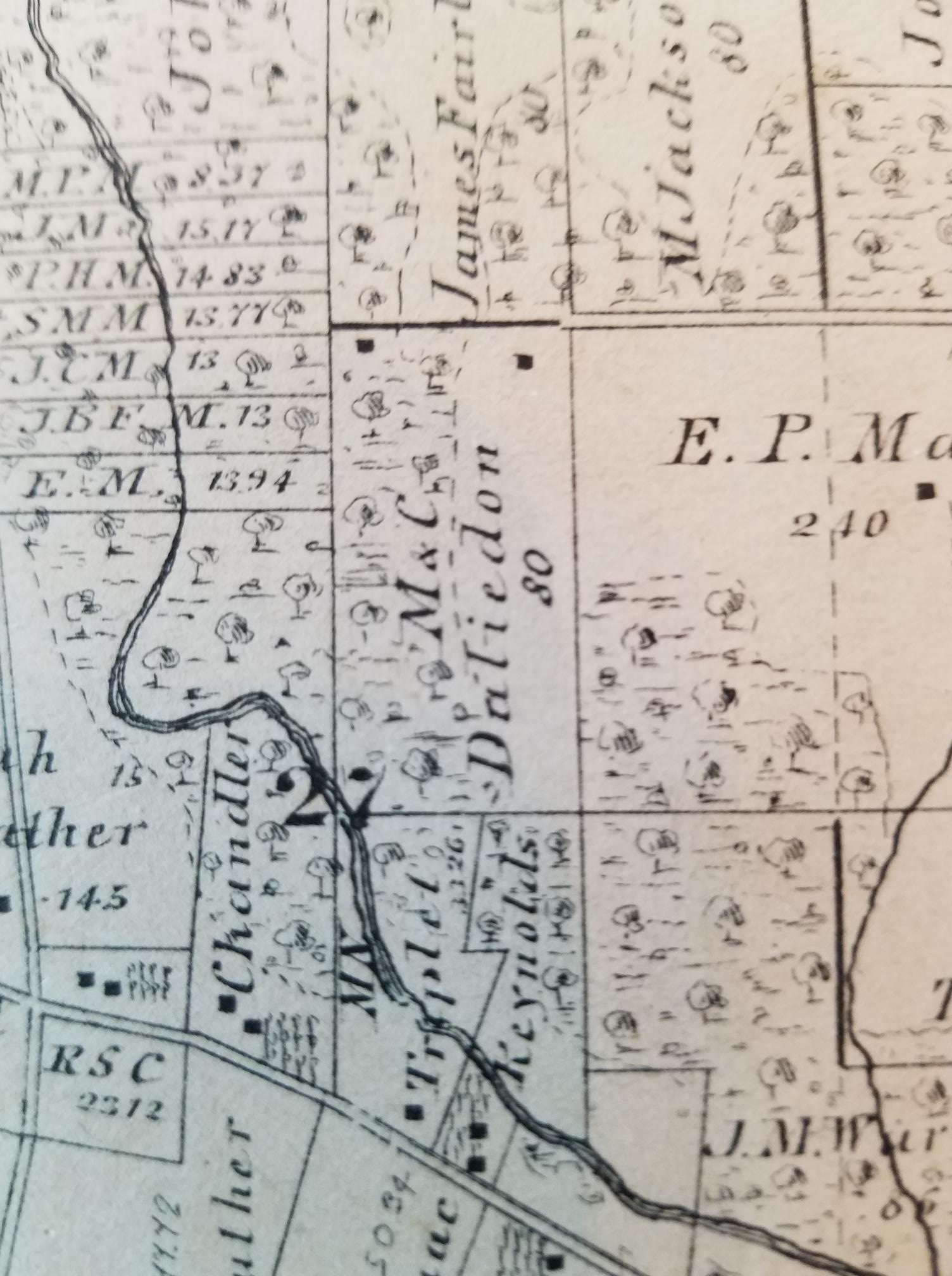
1874 Atlas of DuPage County showing section 27 of Winfield Township in Illinois. This shows Michael and Christopher’s jointly owned farm property. Source: Illinois Digital Archvive link: http://www.idaillinois.org/digital/collection/npl/id/11053

In reviewing the New York, U.S. Arriving Passenger and Crew Lists (1820-1957) available on Ancestry.com we search and find the name: “Michel Dahleiden“. Michael arrived on 17 October 1856 at Castle Island in New York City. He left Europe from the port of Antwerp in Belgium. His ship was the David Hoadley. He was sixteen (16) years old. It is uncertain whether he was traveling with anyone we can verify were his neighbors or extended family members. We can speculate that he was what I would call an “advance person” from the Daleiden family who arrive prior to the other members traveling and settling in America. This is what is called ‘chained migration’. One of the names on the passenger list with Michael is that of a man with the last name of Arends. I will have to following the lead on this person to see if they also settled in Winfield.

It would not be until 7 December 1857 that Michael would be joined by his father Matthias and his brothers Christopher and Peter, and sisters: Barbara (age 22) and Barbara (age 13). They came from Ralingen, Landkreis Trier-Saarburg, Rheinland-Pfalz, Germany. For more information on Matthias’ and Christopher’s immigration see my blog posting on that topic.

There is an information gap on the whereabouts of Michael from the time he entered the Castle Island immigration area on Battery Park in the port ot New York City in 1856 to 1865. I will continue to explore possible paths Michael may have taken once arriving in America. Further research is required.

The next trace in official records where we locate Michael is on the Illinois 1865 Manufacturers and Agriculural Census. The following information is revealed (the date of the census 3 July 1865) about this family and their property and farm. The property is located in Winfield Township Dupage County Illinois. We are now nine years after Michael arrived in America.

Michael is listed at the ‘head of the household on the 1865 Illinois Census. There are three “hashmarks and counted” people listed as “white persons over age twenty and under age of thirty. No names are listed. I am making an assumption that the people with hashmarks include: One is a male (Christopher), two are females (Maggie Weiland and Barbara Daleiden). There are two “white persons over thirty and under forty (Michael and Katherine Daleiden). One person a male (Matthias, the father) is the only “white person over fifty and under sixty” listed.

In terms of the commodities produced and or value of property: the Census lists only $ 25 worth of oats. The Census does not enumerate any other items such as livestock or products.

The 1870 U.S. Census (taken on 7 August 1870) accessed through Family Search online shows the following: Matthias Daleiden the father is now sixty-five and is a “retired farmer”, Michael is now thirty-four, Christopher is thirty-two, Maggie (Christoher’s wife) is twenty-nine (and Keeping House) and Barbara a two month old infant – Chris and Maggie’s first child born in March of 1870. Their real estate is valued at $ 3,000 and they own $ 300 worth of personal property. We do not see the two sister of Chris and Michael listed as living with the family.

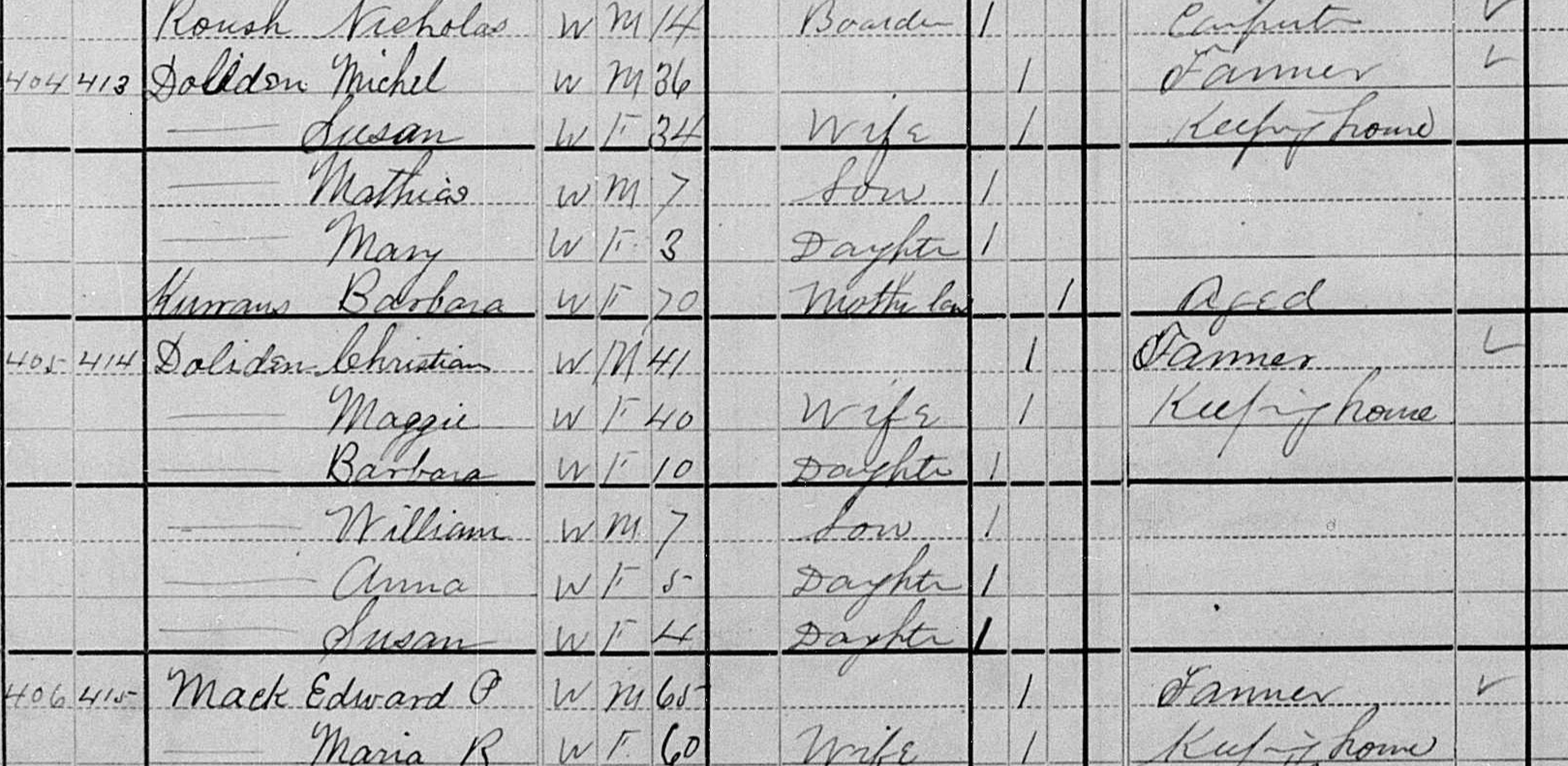
1880 Census Mack Road in Winfield Township, DuPage County, Illinois near the Village of Winfield Illinois.
Source: Family Search.com: https://www.familysearch.org/ark:/61903/1:1:M67R-FG5

The 1880 Census reveals that Michael is now farming his own land near his brother Christopher.

1904 Atlas showing the two brothers farming on properties they own side by side as neighbors. Source: 1904 Atlas of DuPage County Illinois. Link to Atlas at the Illinois Digital Archives: http://www.idaillinois.org/digital/collection/npl/id/11552.

Michael is now married by 1880. The U.S. Census for 1880 was taken over a two day period of time on the 22nd and 23rd of June of 1880. It records Michael (36) now living with his wife Susan Daleiden (34 years of age) they have two children Mathias age 7 (born 1873), Mary age 3 (born 1877). Susan’s mother “Barabard Kurrans” is living with the family (age 70 born 1810).

Next door to the farm just west along the West Branch of the DuPage River is Michael’s brother Christopher. Chris (41) is living with his wife Maggie (40), and their four children: Barbara (10), William T. (7), Anna (5) and my great grandmother Susan (4).

The 1880 Agricultural Non – Population U.S. Census Schedule was taken on the 23 June 1880 for Winfield Township and reveals how much the two brothers have prospered since immigrating to America.

Michael has twenty acres under tillage and twenty acres (20) listed under “Premanent meadows, pastures, orchard, vineyards“. His farmstead is valued at $ 1,800. He owns $ 100 worth of “farm implements and machinery”. He has $2,000 worth of “livestock”. An estimate value of all farm production for 1879 is $ 800. He has twelve acres of property either “mowed, hay field, or grass seed” harvested.

Christopher, his brother, has thirty (30) acres of tilled property, with twenty acres of “Premanent meadows, pastures, orchard, vineyards“. The value of his property is $2,000. He owns $75 worth of “farm implements and machinery“. He has $2,300 worth of “livestock“. An estimate value of all farm production for 1879 is $ 400.

DuPage County area farms at this time frame in the 1880s and 1890s were becoming predominantly producers of milk and other dairy products. Also reflected in the census is the fact that more wheat then corn was being produced at the time. This would change dramatically by the late 1880s and early 1900s as “corn became the king” in terms of production on Illinois farms. Wheat production and harvesting would move to the expanding western plains states and territories as they began to be settled.

Michael and Chris owned eight milk cows between their two properties and four other types of cows. They had seven calves born on their properties over the past year. They produced 1000 lbs. of butter. They owned fifty chickens that produced two-hundred (16.5 dozen eggs). They grew: buckwheat, indian corn, oats, rye and harvested eighty-five acres of wheat between their two farmsteads. They grew one hundred fifty bushels of “Irish Potatoes”, fifty bushes of apples were grown and picked their orchards. They sold only $10 of their products as “Market Garden” during the previous year. It is assumed that most of their crops or livestock were consumed by their families with little of their produce or products being sold to outside individuals. Some of their products and milk were no doubt shipped to Chicago via the Chicago of Northwestern Railroad depot in Winfield. Farmers would transport their products by moving them on horse drawn wagons to the depot.

For more on what happened to Michael from 1904 to the time of his death on 15 February 1916 click this link here.

Posted in Daleidens, Michael Daleiden, Uncategorized | Leave a comment

Mae Schlick Meets Herbert Hoover at St James Farm? Say What?: Taking a Sidetrack Journey on Family History.

We all have all at one time in our lives done this before. You know what I am talking about. Getting sidetracked when you are in the middle of a project or house work etc. etc. We get atttracted by B.S.O (or “bright shiny objects“) as professional genealogist Thomas MacEntee would call the issue. It gets us sidetracked in our research journey and we lose our focus. My oldest daugher Meredith would call it ADD.

One of those BSO moments took place when I was doing an oral history interview with my Grandmother Mae Catherine (nee Hodous) Schlick in winter of 1983. I was in my senior year at Rosary College (now Dominican University) in River Forest Illinois. My Professor Robert J. Rusnak assigned students to do an oral history interview with someone who lived during the Great Depression. The class was one of my favorites and was titled: Contemporariy America 1932-1945: The Great Depression and World War II.

Image for event: The Other McCormick of DuPage - Zoom event
St James Farm Warrenville Illinois a view of the former Guernsey dairy barn. Photo Credit: Forest Preserve Disrict of DuPage County Illinois.

During the interview with Grandma Schlick she had mentioned that one of her jobs was cleaning house for the Chauncey McCormick family at their St. James Farm equestrian and Guernsey dairy estate (Warrenville, Illinois). My grandfather Frank J. Schick worked in the barns and fields of St. James begiining as a teenage from the mid-nineteen twenties until his retirement in 1985. Grandma casually mentioned during her interview that she had met Herbert Hoover sometime in the 1930s while cleaning the McCormick home. I thought to my self “let me make a note of this and get back to it when I have the time.”

George S. Davis my father and my Grandmother Mae C. Schlick at St. James Farm in Warrenville Illinois Winfield Township DuPage County Illinois. This photo was taken around the late 1950s. Source: George S and Louse E. Davis Estate Archives.

After college graduation and prior to getting married in 1988 I had time to pull out my family history materials. I wrote to the Herbert Hoover Presidential Library in West Branch Iowa to see if they had any papers or letters regarding Chuancey McCormick in the archive. The response was in the affirmative. They had three boxes of letters, telegrams and material written or exchanged between McCormick and Hoover. I requested that they copy the entire archive and mail it to my home in Winfield.

In sifting through the Hoover/McComick correspondence, I was able to verify the fact that Hoover had been invited to the farm on two occasions. The first was on 3 July 1942. He also visited and stayed overnight on the farm in McCormick’s home on Sunday the 17 August 1944. I was pleased that my hunt about the BSO had been fruitful!

How had McCormick come to know and work with Herbert Hoover? McCormick had been a Captain and was later appointed as a Lieutenant during World War 1 in the U.S. Army Quartermaster Corp under General Dawes. He lived in Paris France for sometime just prior to and after the war. In 1918 following the War, Chauncey was hired by Herbert Hoover to be part of the Polish Food Relief effort to feed the starving children and women of war torn Poland. This story is a facinating one best left for another blog posting or article.

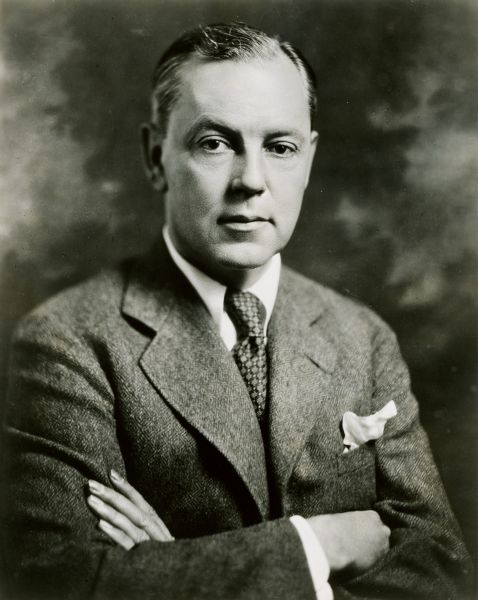
Chauncey McCormick, member of the International Harvester Board of Directors from 1936 until his death in 1954.  His grandfather William McCormick was Cyrus McCormick's brother.
Chauncey Brooks McCormick
(December 7, 1884 – September 8, 1954) )
Photo Courtesy of the Wisconsin State Historical Society
International Harvester McCormick Archives

Posted in St James Farm, Uncategorized | Leave a comment

David McCullough on Books, History, Writing, and American Democracy: “You’ve got to marinate your head, in that time and culture. You’ve got to become them.”

(Note: David McCullough died on August 7, 2022. Here is a post regarding some reflecting on his passing.)

One of my favorite writers is David McCullough. David is an excellent writer and storyteller of the American past. He is also a watercolorist painting and sketching in his free time and once said that he “Paints with words” in his books and writings. The best advice I have taken from his interviews and writing is that when writing about a person or history “You’ve got to marinate you head, in that time and culture. You’ve got to become them“. This is in reference to biographical writing.

True to his words and advice McCullough would often travel to the locations where his subjects lived to feel and experience the places they called home or where they worked. He did this with his research on the John Adams and Harry S Truman biographies. He actually lived for a time near the Brooklyn Bridge when working on the history of the building of the bridge.

One exteme example of just how involved he was in his research, for the Truman biography, McCullough retraced and walked Harry Truman’s route through the U.S. Capitol to pace out the time it took to walk from Truman’s office as the Vice President and President of the Senate upon getting a call from Steve Early the Press Secretary at the White House summoming Truman to come “immediately” to the White House. Once at the White House he heard about the death of Franklin D. Roosevelt from Eleanor Roosevelt. Truman asked the First Lady “Is there anything I can do for you Mrs. Roosevelt ?” and Eleanor’s reply was “Harry is there anything we can do for you, for you’re the one in trouble now”.

Our ancestors did not live in a bubble and we should not be in one when researching and writing about their lives. We need to understand how they lived and “marinate” ourselves per McCullough in their time and put our focus and thoughts inside their minds and the age in which they lived. I have attempted to do this in my family history research. History and events happen and people that lived through their times often did not know how things would turnout.

I am fortunate to be living near many of the Daleidens and Schlicks homes and former properties. I still get chills when driving east on Mack Road near Warrenville Illinois toward the Winfield and Mack Road intersection and I drive pass the former Daleiden/Schlick farmstead property. When crossing the Mack Road bridge over the Dupage River West Branch I feel the spirit of my grandparent Frank and Mae Schlick and fill my lungs and breath with their spirit as I rush over the bridge and past the home site.

The Schlick Family at the Mack Road dairy farm homestead site near Warrenville Illinois.

Here are some of my favority quotes from David McCullough concerning writing, reading, books and the study of our nations history and past:

“You’ve got to marinate your head, in that time and culture. You’ve got to become them.”
(Speaking about researching, and reading, and immersing yourself in History)”
― David McCullough, John Adams

How can we know who we are and where we are going if we don’t know anything about where we have come from and what we have been through, the courage shown, the costs paid, to be where we are?”
― David McCulloughBrave Companions: Portraits in History

“No harm’s done to history by making it something someone would want to read.” (The Course of Human Events, NEH Jefferson Lecture in the Humanities 2003)”
― David McCullough

“I must study politics and war that my sons may have liberty to study mathematics and philosophy. My sons ought to study mathematics and philosophy, geography, natural history, naval architecture, navigation, commerce, and agriculture in order to give their children a right to study paintings, poetry, music, architecture, statuary, tapestry, and porcelain.”
― David McCulloughJohn Adams

“You can’t be a full participant in our democracy if you don’t know our history.”
― David McCullough

“If you get down about the state of American culture, just remember there are still more public libraries in this country than there are McDonalds.”
― David McCullough

“Any nation that expects to be ignorant and free,” Jefferson said, “expects what never was and never will be.” And if the gap between the educated and the uneducated in America continues to grow as it is in our time, as fast as or faster than the gap between the rich and the poor, the gap between the educated and the uneducated is going to be of greater consequence and the more serious threat to our way of life. We must not, by any means, misunderstand that.”
― David McCullough

“Nothing ever invented provides such sustenance, such infinite reward for time spent, as a good book.”
― David McCullough

“History is a guide to navigation in perilous times. History is who we are and why we are the way we are. ” ― David McCullough

Posted in Historical Writing Resources, Uncategorized | Leave a comment

History Quote by James Baldwin for Black History Month February 2022

“History, as nearly no one seems to know, is not merely something to be read.  And it does not refer merely, or even principally, to the past.  On the contrary, the great force of history comes from the fact that we carry it within us, are unconsciously controlled by it in many ways, and history is literally present in all that we do.  It could scarcely be otherwise, since it is to history that we owe our frames of reference, our identities, and our aspirations.” – James Baldwin in Ebony Magazine article 1965 titled “White Man’s Guilt“.

As a family historian I agree with Baldw in that “we owe [history] our frames of reference, our identities, and our aspirations.” “. . . we carry it with us“. I find more and more this statement or quote to be true as I get older and continue to delve into the history of our country.

Posted in Historical Writing Resources, Uncategorized | Leave a comment

History of St. James Farm Forest Preserve in Warrenville Illinois

Here is my presentation that I provided to the Wheaton Illinois Public Library in 2021 on the History of the St. James Farm Forest Preserve in Warrenville Illinois. This is the link to the Wheaton Library YouTube station where the presentation is now archived. I also had the distinct privilege to present the progam in Freedom Hall (i.e. The Library Wing) at the Col. Robert R. McCormick Museum in Wheaton illinois in November 2019.

This is where my grandfather Frank J. Schlick worked as the Farm Manager. I will have a posting on my Grandfather in the future.

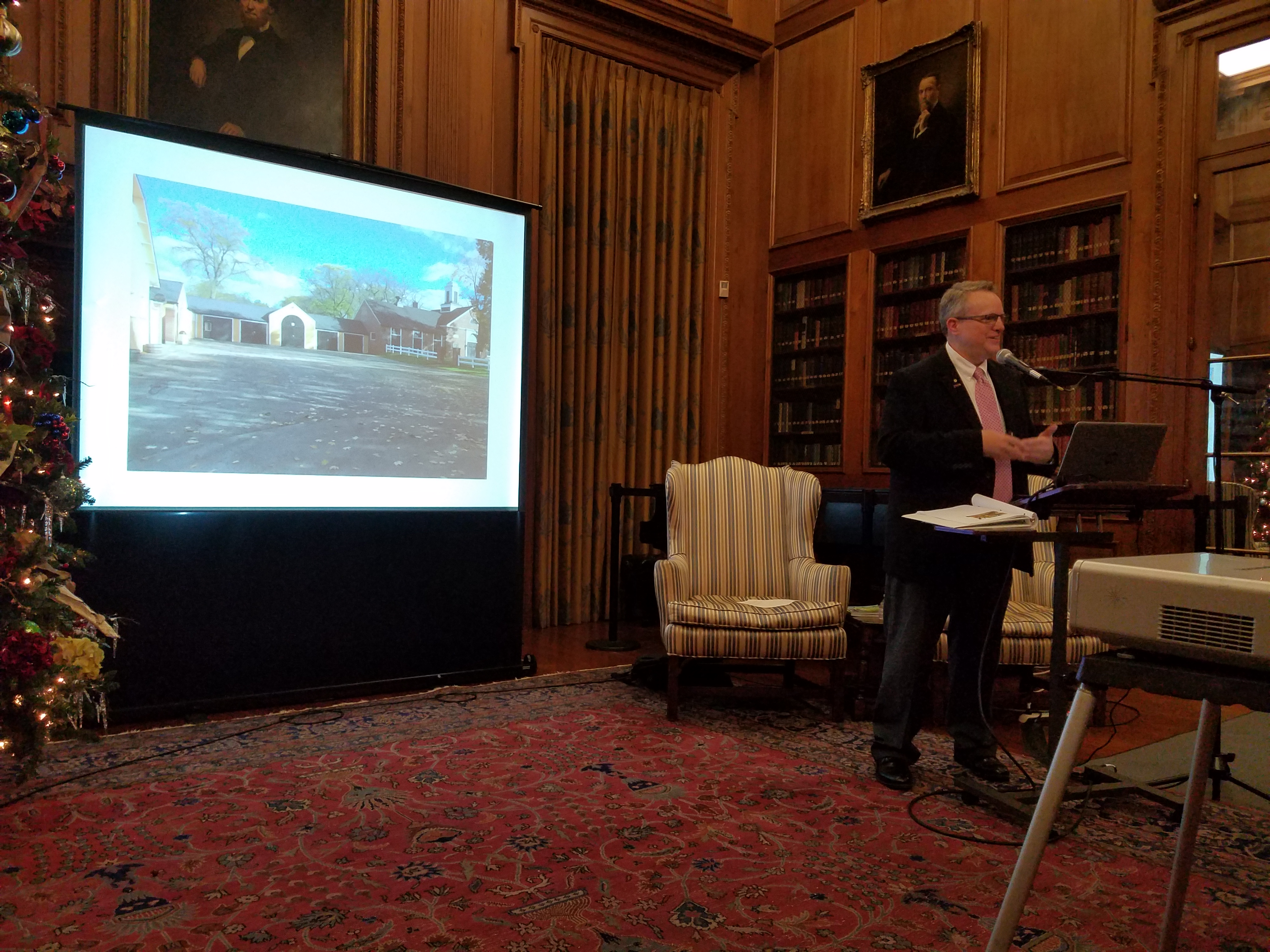
Kevin Davis at the RR McCormick Museum Library in Wheaton Illinois giving a lecture on the History of St. James Farm November 2019. Photo Credit: Kevin Davis Photo Archives.
Posted in St James Farm, Uncategorized | Leave a comment

Chauncey McCormick of St. James Farm in Warrenville Illinois

My grandfather Frank Schlick worked from the mid 1920s to 1985 for Chauncey McCormick and then his son Brooks McCormick at St. James Farm. The farm is now part of the Forest Preserve District of Dupage County. Here my my presentation on Brook’s father Chauncey McCormick. This is on the Winfield Public Library in Winfield Illinois YouTube Station. Enjoy!

Chauncey McCormick. Photo Courtesy of IH / McCormick Archives Wisconsin State Historical Society. Source Link: https://preview.wisconsinhistory.org/Records/Image/IM59729
Posted in St James Farm, Uncategorized | Leave a comment

The German Immigrants of Winfield, Illinois.

Winfield, Illinois is located in Winfield Township DuPage County Illinois. Today (2022) it contains a population of 9,700 people. In reviewing the growth of this community in the mid -1850s it contained a handful of German farmers and merchants. In 1880 the population was 164 people and by 1930 it had grown to 445 people. It has always been a smaller community when in comparison to the near by citys of Wheaton, Naperville and West Chicago in DuPage County Illinois.

Rees map of Chicagoland area 1849. This is the earliest map of this area. It includes the Chicago and Galena Railroad tracks on this map. Source: https://commons.wikimedia.org/wiki/File:1851_Rees_map_of_Chicagoland.jpg
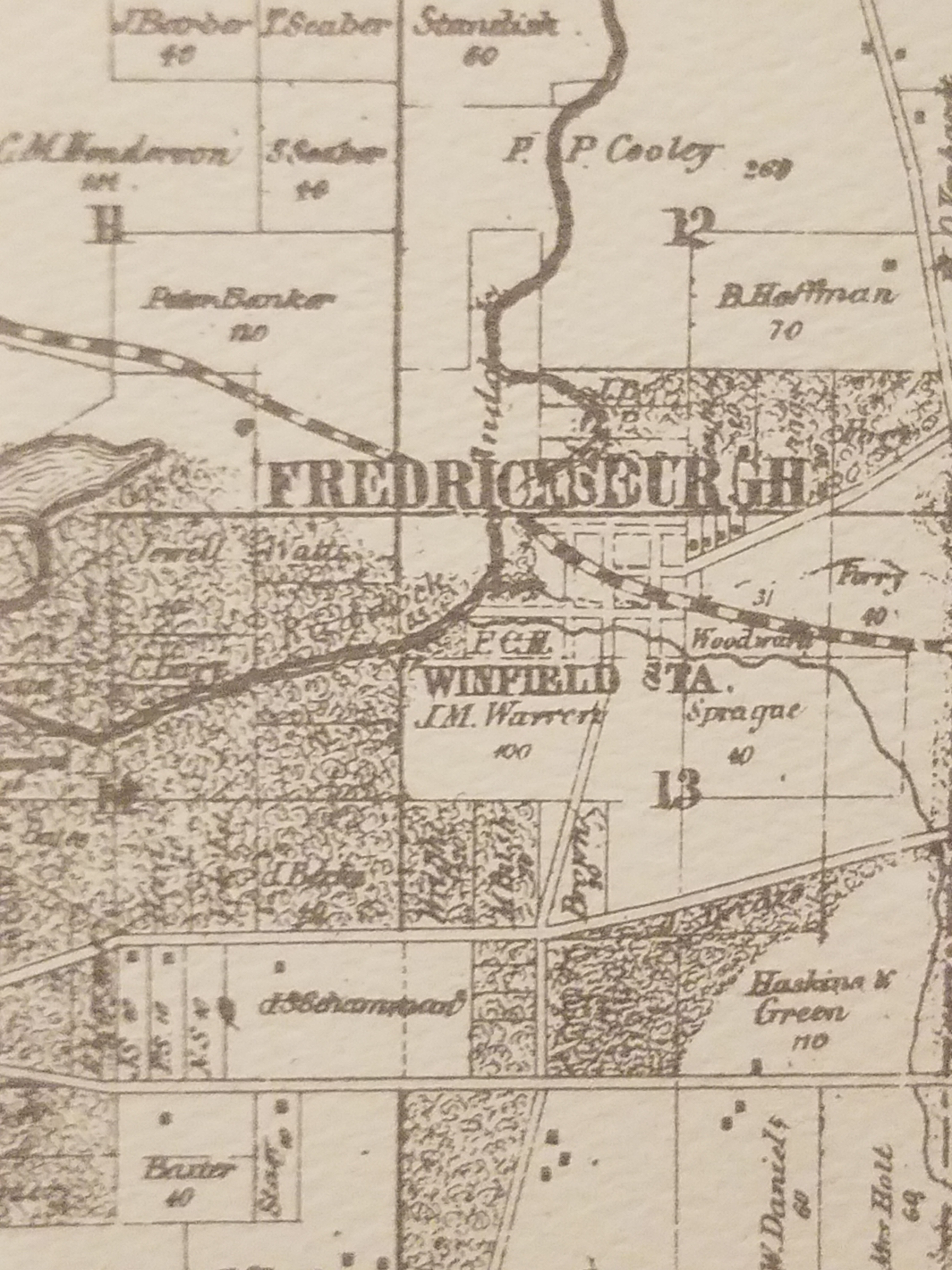
1863 Map of the area of Fredericksburg Illinois now Winfield Illinois. Julius Warren is one of the earliest key landholder of this area. Warren (or Col. Warren) was the founder of Warenville located 3.8 miles south of Fredericksburg.
Source: Dupage County Illinois Historical Museum Wheaton Illinois.

A description in the 1874 DuPage County Atlas of Winfield records this description:

Winfield Station (recorded as Fredericksburg) was platted on January 25, 1853 by J.P. Doe. It is a station on the main line of the Chicago and Northwestern railroad and three miles west of Turner (now West Chicago). It has on Church the St. John’s German Roman Catholic, which was organized in 1867 with twenty members, and had increased to fifty-five. The Society has a substantial church, erected in 1867. There is one common school with fifty-eight pupils in attendance.

1851 Rees Map of Chicagoland Area. This is a closeup showing the area of section 27 near the Daleiden property in Winfield Township Dupage County Illinois. This map is another of the earliest maps of the area. Source: https://commons.wikimedia.org/wiki/File:1851_Rees_map_of_Chicagoland.jpg

In reading journals and eyewitness accounts of the area we gain a sense of what Winfield Township was like. A reporter for the Prairie Farmer newspaper provides a description of the area around 1854 three years prior to the Daleiden family arriving around 1857:

Winfield is a place where one may stop by means of a good understanding with the conductor. This step is necessary for though he should look with double power microscope he would find no town big or little here.

1871 Map of Winfield Township Dupage County Illinois. Shows section 27 where the Daleidens and Schicks had their property and farmstead along the DuPage River. Winfield Station, ie. Fredericksburgs is in the upper righthand corner of this map. Source: University of Wisconsin Milwaukee Collections: https://collections.lib.uwm.edu/digital/collection/agdm/id/1338

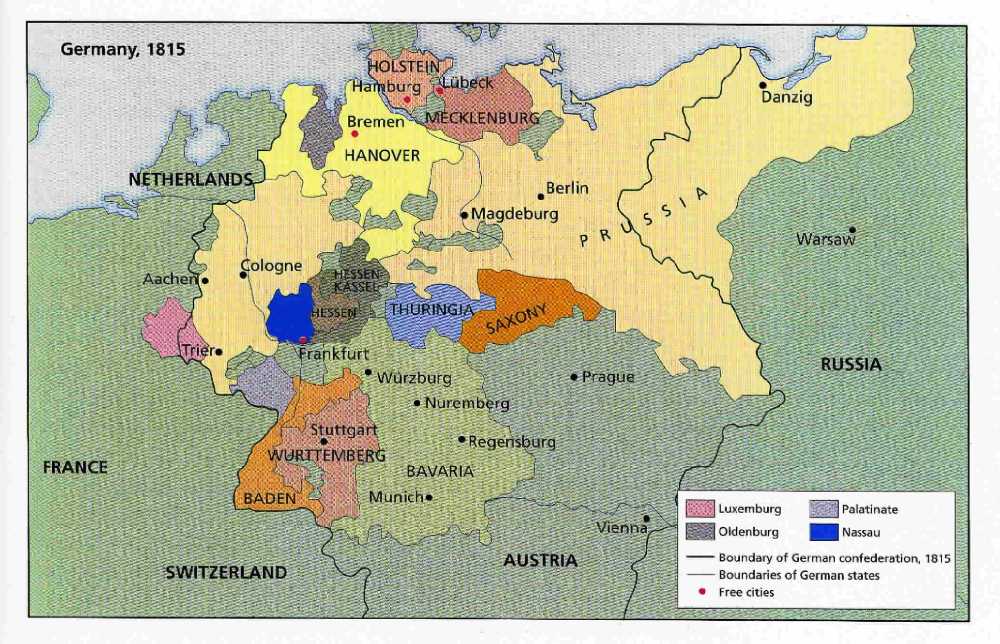
Where had the German Immigrants come from in the 1860s? Louise Spanke in her book Winfield Good Old Days (1978) makes this observation regarding the new German immigrants to Winfield: “for a significant number of the newcomers recorded in 1860 and successive censuses, a small area perhaps twenty mile diameter, around Bitburg and south across the Luxembourg border, had been home“.

Tier is shown in this map in Red.

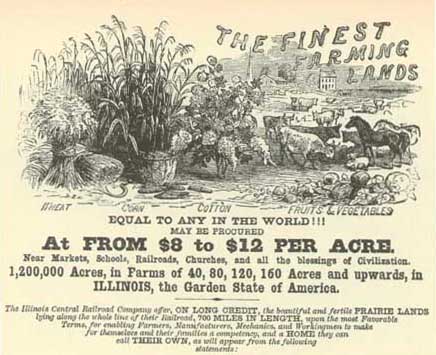
Most of the German Immigrants had either come on their own and in many cases they had come due to ‘chained migration‘. Chained migration is the theory that many immigrants followed some of their neighbors and relatives who had previously settled in German enclaves in the Midwest in areas around or in the cities of Chicago and St. Louis. Word of mouth via letters and or newspaper accounts attracted many new immigrants. By 1832, more than 10,000 immigrants arrived in the U.S. from Germany. By 1854, that number had jumped to nearly 200,000 immigrants. In the decade from 1845 to 1855, more than a million Germans fled to the United States to escape economic hardship. They also sought to escape the political unrest caused by riots, rebellion and eventually a revolution in 1848. The railroads placed ads in many German language newspapers in an effort to attract settlers to purchase and settle on land along railroad routes. Here is an example of an ad:

Illinois Central Railroad Poster advertising land for sale. Source: Illinois State Museum website: http://www.museum.state.il.us/OHIA/images/human_settlement/illinoislands_rrposter.jpg

Germans were considered clannish by their non-Catholic New England protestant emigrants in nearby Wheaton and other parts of DuPage County (see Jean Moore, Building Your Own Town . . . The Carol Stream Story, 1984). Many German families that settled within the area included families per Moore such as the Dieters, Kleins, Schramers, Hahns, Kammes and Fischer.

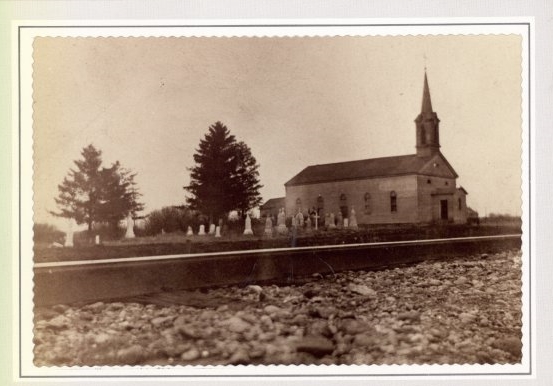
German immigrants worked to establisher their own ethnic churchs. In the Winfield and Wheaton area for instance German Catholic farmers and merchants had to travel to either the Saint Peter and Paul Catholic Church in Naperville (7.5 miles to the south east of Winfield) or they had to traveled to the Mission Church of St. Stephen located (4.3 miles to the northwest of Winfield) in Gretna Illinois in Milton Township prior to the establishment of St. Michaels in the City of Wheaton Illinois or St. Johns in Winfield Illinois. Many of the descendants of the families could recall having to get up as early as 4:00 a.m. in the morning in order to get to Church on time prior to the start of the Mass at the churches. Often times this was during harsh weather (snow, rain, sleet, high winds, heat and cold, etc.) over roads or pathways that were neither paved nor grated. Carriages and horses would become bogged down in the mud following a rainstorm.

The Mission Church of St. Stephens located in the former settlement of Gretna Illinois now Carol Stream Illinois in Milton Township DuPage County Illinois. The cemetery is the only trace left of this settlement and Church. Gretna is now part of Carol Stream Illinois. Source of image: Dupage County Historical Socicty Collection: https://dupage.pastperfectonline.com/Photo/87B0C2E5-C6D5-4F81-8059-827323009026.

Language was a barrier for many new immigrants and newcomers from Germany coming into the Chicagoland and Winfield Township areas of DuPage County. German was spoken in schools, at home and in the town of Winfield until the U. S. entry into the First World War ( December 1917).

The new immigrants and most likely the Daleiden family brought with them their cultural traits: a desire to educate their children, the freedom to continue to worship as Roman Catholics in their newly adopted country, and a desire to own land and property. From my perspective and in talking to my Schlick Grandparents I can tell that many of these traits were passed down and instilled in me: get a good education (“something that people cannot take away from you“), own land and property, and have a firm believe in God and to believe that God is with you always and will guide you through life.

Posted in German Immigration History, Uncategorized, Winfield History | Leave a comment

A December 1857 Passenger List Reveals Daleidens Arrival in the United States

Source of Passenger List Image: “New York, New York, Index to Passenger Lists, 1820-1846.” Database with images. FamilySearch. http://FamilySearch.org : 5 December 2020. Citing NARA microfilm publication M261. Washington, D.C.: National Archives and Records Administration, n.d.

The Matthias Daleiden family arrived in the port of New York, New York City, at Castle Island on the 7 December 1857. Shown above is the actual passenger list. The Daleidens are passenger numbers 90 to 94. The family members (note the absent of Matthia’s eldest son Michael Daleiden) on the ship manifest include: the father Matthias Daleiden (age 53), Christopher (age 20), Peter (age 17), Barbara (age 22) and Barbara (age 13). Matthias and Christopher mention to the port authority they are “farmers” from “Prussia”. Their destination is recorded as “Illinois”. Why two Barbaras? For the answer to that question go to my posting on German naming conventions. For the answer on where Michael is locateed at this time go to my posting regarding Michael’s arrival in America.

The E. C. Scranton ship that the Daleidens traveled on crossing the North Atlantic Ocean from Antwerp to New York.

The trip from Antwerp to New York City was in the nineteenth century 4,000 nautical miles across the North Atlantic Ocean. Source: The Moser Family Genealogy Blog: https://mosergenealogy.wordpress.com/2020/03/13/the-voyage-of-the-barque-hiero/amp/

The family journeyed from the port of Antwerp in Belgium over a seven week period on the choppy waters of the north Atlantic Ocean on the sailing ship the E.C. Scranton. The ship according to records had three decks and three masts. The Scranton weighted 1,186 tons and had been crafted of white oak and cedar and was 180 feet in length the size of a football field and 37 feet in width.

Image Source: The Miriam and Ira D. Wallach Division of Art, Prints and Photographs at the New York Public Library. “State Emigrant Landing Depot, Castle Garden, N.Y.” The New York Public Library Digital Collections. 1861 – 1880. https://digitalcollections.nypl.org/items/510d47da-2802-a3d9-e040-e00a18064a99.

The Daleidens place of origin noted on the passenger list was “Prussia”.

Several questions are now forming as I continue my research journey. Why had the Daleidens and the Schikc come to America? Did they know anyone already living in the United States and in the State of Illinois? What drove Matthias to bring his entire family on an arduous seven-week journey to America? The family would be traveling in all likelihood with people they did not know. Would they survive the seven weeks and not contract any illnesses or a disease? At this point in my research I do not have any concrete answers in writing contained in any letters nor diaries the family left behind. One option is to turn to the writings of other European and German historians in order to gain a general understanding and context of what others immigrants had experienced. I will attempt to answer some of these questions in future posts.

Posted in Daleidens, Uncategorized | Leave a comment